Key takeaways
- Two verified glute ham developers compared by frame, padding, adjustment range, capacity and footprint for home and garage gyms.
Disclosure: As an Amazon Associate, we earn from qualifying purchases.
Our top pick: Titan Fitness Glute and Ham Developer, Adjustable GHD Machine. Runner-up: Valor Fitness Adjustable Glute Ham Developer GHD Machine (CB-29).
A glute ham developer, usually shortened to GHD, is a very specific piece of strength equipment. It is not a hip thrust bench, it is not an abductor machine, and it is not a simple hyperextension bench with a new name. A true glute ham developer holds the ankles firmly, supports the thighs on a large curved pad, and leaves the hips free to hinge, so the lifter can perform glute ham raises, controlled lowering work, back extensions, and GHD sit-ups from one station. That fixed ankle position and that large thigh pad are what separate the machine from smaller, lighter alternatives.
This guide covers only glute ham developers, and only models checked against a real Amazon US listing with a verified ASIN. That discipline matters here, because search results for glute training mix together several different machine types. Hip thrust machines, hip abductor machines, and glute gliders can all be useful in the right programme, but they do not load the hamstrings in the same way as a GHD, and they were deliberately left out of this guide. Padding a list with a different product type would make the list longer without making it more useful.
Only two models met that standard here. The first is the Titan Fitness Glute and Ham Developer, a heavy machine built around an 11-gauge steel frame, HeftyGrip vinyl padding, and ten adjustment settings. The second is the Valor Fitness Adjustable Glute Ham Developer, model CB-29, a lighter machine built around a 12-gauge steel frame, with six horizontal and four vertical adjustments, band pegs, and an Olympic plate storage bar. Between them they cover the two most common buying situations: the heaviest, most planted station that will fit, and a GHD that is easier to move and store while still adjusting enough to share between lifters.
Quick Picks
- Titan Fitness Glute and Ham Developer, Adjustable GHD Machine — Best overall pick: the heavier frame in this guide, with 10 adjustment settings, HeftyGrip vinyl padding, padded ankle rollers, and a stated capacity of 350 lb.
- Valor Fitness Adjustable Glute Ham Developer GHD Machine (CB-29) — Best lighter and more mobile pick: a 122 lb machine with 6 horizontal and 4 vertical adjustments, band pegs, an Olympic plate storage bar, transport wheels, and a stated capacity of 400 lb.
Titan Fitness Glute and Ham Developer, Adjustable GHD Machine

OUR TOP PICK
The Titan Fitness Glute and Ham Developer is the top pick in this guide because it is the more substantial machine of the two, and for this type of equipment, substance is not a cosmetic detail. A glute ham raise places a long lever of body weight against the pad and the ankle rollers, and the lifter effectively tries to fold and unfold that lever under control. Any flex, rocking, or shifting in the frame is felt immediately, and it is felt most on the slow lowering phase, which is the phase that does much of the useful work. A heavy, planted frame is therefore a training feature, not simply a shipping inconvenience.
As stated on the listing, this is an adjustable GHD machine for glutes, hamstrings, lower back, and GHD sit-ups. The frame is heavy-duty powder-coated steel, built from 11-gauge steel, and the stated weight capacity is 350 lb. The machine itself weighs 190 lb, considerably heavier than the Valor model below, and that weight is a large part of how the station behaves in use. Once positioned, it stays where it was put, which suits a dedicated corner of a garage gym or a permanent spot in a home training room where the floor plan rarely changes.
Padding is the other detail that decides whether a GHD gets used hard or gets avoided. The listing states HeftyGrip vinyl padding, along with padded ankle rollers. The thigh pad has to support the front of the thighs through repeated sets without feeling like a narrow bar digging in at the hinge point, and the ankle rollers have to hold the heels and lower calves firmly without creating a single painful pressure point. A grippier pad surface also helps the lifter stay positioned during sit-ups and extensions instead of sliding forward as the set goes on and the work gets harder.
Adjustment comes from 10 settings, as stated on the listing. That range matters because correct GHD setup is personal. The distance from the footplate to the pad changes where the pad meets the thighs, and that meeting point changes the difficulty and feel of a glute ham raise more than almost any other setup choice. Set the pad too far forward and the movement becomes a very hard knee-flexion exercise with little hip contribution. Set it too far back and the lifter can hinge too freely and lose hamstring tension. Ten settings give a finer ladder of positions, helping one lifter dial in a repeatable setup and helping two lifters of different heights share the machine.
Size needs a clear statement. As stated on the listing, the overall height is 41 inches, the width is 45.5 inches, and the depth is 70 inches. That depth is the figure to plan around, and the lifter still needs working room beyond the frame at the front during certain movements. The listing also states that the machine has wheels for mobility and storage, which helps with short moves across a flat floor, such as rolling the machine aside to free a lifting platform. Wheels do not turn a 190 lb machine into equipment most people will want to move every day, so treat it as movable when needed and stationary by default.
Specs
– Model: Titan Fitness Glute and Ham Developer, Adjustable GHD Machine
– Part number: HDGHD1-HDGHD2, as stated on the listing
– Manufacturer: Titan Fitness
– Frame: Heavy-duty powder-coated steel, 11-gauge steel frame, as stated on the listing
– Padding: HeftyGrip vinyl padding and padded ankle rollers, as stated on the listing
– Adjustment settings: 10, as stated on the listing
– Weight capacity: 350 lb, as stated on the listing
– Overall height: 41 in, as stated on the listing
– Overall width: 45.5 in, as stated on the listing
– Overall depth: 70 in, as stated on the listing
– Product weight: 190 lb, as stated on the listing
– Mobility: Wheels for mobility and storage, as stated on the listing
Pros
– Heaviest frame in this guide, at 190 lb, for a planted feel during hard sets
– 10 adjustment settings for a finer choice of pad position
– HeftyGrip vinyl padding with padded ankle rollers
– Sturdy footplate and wheels for occasional repositioning
Cons
– Largest and heaviest machine in this guide, so it needs a permanent spot
– 70-inch depth is a lot of floor space for a compact home gym
– Lower stated capacity than the Valor model below, at 350 lb
Valor Fitness Adjustable Glute Ham Developer GHD Machine (CB-29)
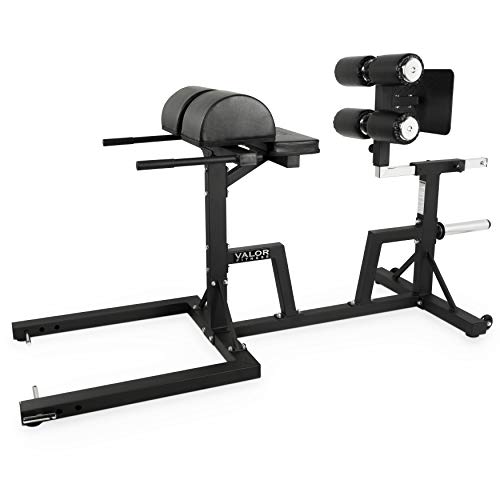
The Valor Fitness Adjustable Glute Ham Developer, model CB-29, is the runner-up in this guide, and it earns that place by being the easier machine to live with in a smaller or shared space. As stated in the listing copy for this model, the frame is 12-gauge steel with a 2 inch by 2 inch frame, the stated weight capacity is 400 lb, and the item weight is 122 pounds. That is still a substantial piece of equipment, not a light folding bench, but it is 68 pounds lighter than the Titan above, and that difference is felt every time the machine is shifted, turned, or rolled out of the way.
The adjustment system is split into two directions, and that split is the most interesting design point on this machine. The listing copy states 6 horizontal adjustments and 4 vertical adjustments. Horizontal adjustment changes the distance between the footplate and the pad, which is the main setup lever for glute ham raises, just as it is on the Titan. Vertical adjustment changes the height relationship in the station, helping lifters of different builds find a position where the pad supports the thighs properly and the ankle rollers meet the lower leg where they should. A buyer sharing the machine with a training partner of a very different height should look closely at this two-direction system.
Padding is described in the listing copy as high-density dual-layer padding. On a GHD, dual-layer padding is a sensible approach, because the pad has two jobs that pull in opposite directions. It needs enough firmness to support the thighs without collapsing at the hinge point, and enough surface comfort that the lifter can repeat sets without the pad itself becoming the reason the set stops. The thigh pad on a glute ham developer takes concentrated pressure in a small area, repeated across every rep, so density and shape matter far more here than on a general training bench that spreads load across the whole back.
Two added features separate the CB-29 from a bare frame. The listing copy states band pegs and an Olympic plate storage bar, along with transport wheels. Band pegs open up a useful progression path. A resistance band anchored at the pegs can assist a lifter who cannot yet complete a full glute ham raise, by taking some load out of the hardest part of the movement, and bands can also add resistance to back extensions once body weight alone is no longer enough. The Olympic plate storage bar gives plates a home on the frame itself, keeping the area around the machine tidier and putting plates for loaded extensions within reach. In a compact gym, storage built into a large machine is worth real floor space elsewhere.
Specs
– Model: Valor Fitness Adjustable Glute Ham Developer GHD Machine (CB-29)
– Part: AF1018F, as stated in listing copy for this model
– Manufacturer: Valor Athletics Inc., as stated in listing copy
– Frame: 12-gauge steel frame, 2 in x 2 in frame, as stated in listing copy
– Material: Alloy Steel, as stated in listing copy
– Padding: High-density dual-layer padding, as stated in listing copy
– Adjustments: 6 horizontal and 4 vertical adjustments, as stated in listing copy
– Weight capacity: 400 lb, as stated in listing copy
– Item weight: 122 pounds, as stated in listing copy
– Features: Band pegs, Olympic plate storage bar, and transport wheels, as stated in listing copy
Pros
– Higher stated capacity in this guide, at 400 lb
– Lighter at 122 pounds, with transport wheels for regular repositioning
– Adjusts in two directions, with 6 horizontal and 4 vertical settings
– Band pegs for assisted or resisted work, plus an Olympic plate storage bar
Cons
– Lighter frame will not feel as planted as the heavier Titan during maximal sets
– Fewer horizontal pad positions than the Titan, at 6 settings
– Plate storage adds width to plan for when plates are loaded on the bar
How to Choose
Start with the movement, because a glute ham developer is a single-purpose station and the main movement should drive the choice. If the goal is the full glute ham raise, the pad position and the ankle anchor are the heart of the machine. The lifter sets the thighs against the large pad with the ankles fixed under the rollers, then lowers the whole body toward the floor by extending at the knees while keeping the hips extended, before pulling back up with the hamstrings. That movement demands a pad that supports the thighs at the right height, rollers that hold without slipping, and a frame that does not shift as the load peaks. Both machines in this guide are built for that pattern, which is why different machine types were excluded rather than mixed in.
Next, measure the space honestly. The Titan is stated at 70 inches deep, 45.5 inches wide, and 41 inches high, and it weighs 190 lb. Those figures describe the frame alone, not the working envelope around it. Allow room in front of the pad for the body during raises and sit-ups, room at the footplate end for getting the ankles in and out of the rollers, and side room for mounting the pad without climbing over nearby equipment. If the measured space is tight, the lighter Valor, at 122 pounds with transport wheels, gives more flexibility to roll the station aside between sessions. If the space is dedicated, the Titan can be placed once and left alone, which is the simpler life for a machine of this size.
Then look at adjustment, and think about who will actually use the machine. A single lifter needs a system that returns to the same position every time, so the chosen setting can be noted and repeated. Two lifters need enough range that neither of them is compromising. The Titan gives 10 adjustment settings in one ladder, which suits fine-tuning a single pad position. The Valor gives 6 horizontal and 4 vertical adjustments, which suits fitting different body proportions in two directions. Neither approach is automatically better. The right question is whether the main difficulty in your setup is fine pad placement for one lifter, or fitting two different lifters onto the same station.
Consider the frame and the stated capacity together. The Titan uses an 11-gauge steel frame and carries a stated capacity of 350 lb, in a machine that weighs 190 lb. The Valor uses a 12-gauge steel frame with a 2 inch by 2 inch frame, carries a stated capacity of 400 lb, and weighs 122 pounds. Gauge, frame size, machine weight, and capacity each describe a different part of the picture, so no single figure should be read on its own. What matters in training is the combination: a frame that feels steady under the movements you plan, and a capacity figure that leaves a sensible margin above the combined load of lifter and any added plates.
FAQs
What does a glute ham developer train that a hyperextension bench does not?
A glute ham developer fixes the ankles and supports the thighs so the lifter can train knee flexion under load, most directly in the glute ham raise, where the hamstrings work to lower and lift the whole body from the knees. A typical hyperextension bench mainly trains hip extension, with the hamstrings and glutes working through the hip rather than at the knee. Both machines in this guide also support back extensions and GHD sit-ups, as stated for the Titan on its listing, but the glute ham raise is the movement that justifies a dedicated GHD station.
How much floor space does a glute ham developer need?
More than the frame dimensions alone suggest. The Titan in this guide is stated at 70 inches deep, 45.5 inches wide, and 41 inches high, and the lifter still needs clear room beyond the frame for the body during raises and sit-ups, plus access at the footplate to set the ankles under the rollers. Measure the full working area, including the route used to move the machine into place. In a shared space, the lighter Valor at 122 pounds, with transport wheels, is easier to roll aside between sessions and back again when training starts.
How should the pad be set for a first glute ham raise?
Start with a pad position that lets the thighs rest fully on the pad with the hips free to stay extended, and use a shortened range or band assistance while learning the movement. Small changes in pad distance change the difficulty a lot, which is why the adjustment range matters: the Titan states 10 settings, and the Valor states 6 horizontal and 4 vertical adjustments. Change one setting at a time, note the position that works, and repeat that same setup so progress can be measured against a consistent standard from session to session.
Conclusion
For most buyers with a permanent training space, the Titan Fitness Glute and Ham Developer is the top pick in this guide, with the heavier 11-gauge steel frame, HeftyGrip vinyl padding, padded ankle rollers, a sturdy footplate, and 10 adjustment settings in a 190 lb machine rated, as stated on the listing, at 350 lb. The Valor Fitness Adjustable Glute Ham Developer CB-29 is the runner-up and the more practical choice in a shared or smaller space, with a stated capacity of 400 lb, two-direction adjustment, band pegs, an Olympic plate storage bar, transport wheels, and a lighter weight of 122 pounds. Both machines are true glute ham developers, and neither list place was filled with a different type of glute machine. Before buying, measure the floor space including working room around the frame, confirm the adjustment system suits every lifter who will use the station, and choose the machine that will stay set up and ready in the room where the training actually happens.