Key takeaways
- Our Fujifilm GFX100S II review covers the 102MP medium format sensor, 8-stop stabilization, autofocus and video, plus top high-resolution alternatives.
Fujifilm GFX100S II Review: 102MP Medium Format in a Portable Body
This fujifilm gfx100s ii review looks at a camera that brings 102-megapixel medium format image quality into a body roughly the size of a full-frame mirrorless camera. Fujifilm launched the GFX100S II in mid-2024 as a stills-first successor to the original GFX100S, pairing a newly developed 102MP CMOS II sensor with the X-Processor 5 engine, stronger in-body stabilization, and AI-assisted autofocus. The short answer: if you want the finest detail Fujifilm offers in its most portable medium format body, and you mainly shoot landscapes, portraits, commercial work, or fine art, the GFX100S II is the most balanced camera in the GFX line. If you need serious video, faster bursts, or a lower buy-in, one of the alternatives below may suit you better. This review is based on published specifications and widely reported details from Fujifilm and independent coverage, not on detailed research.


Quick Picks
Our Short List of 3
- Check on Amazon
- Check on Amazon
- Check on Amazon
All 3 Picks at a Glance
| Product | Specs | Action |
|---|---|---|
| Fujifilm GFX100S II Body Mirrorless Medium Format Camera Body |
| Check price on Amazon |
| Fujifilm GFX100 II Mirrorless Medium Format Camera Body |
| Check price on Amazon |
| Fujifilm GFX 100 102MP Medium Format Digital Camera (Body Only) |
| Check price on Amazon |
How to Choose
Sensor Size and Resolution
Medium format sensors are larger than full-frame sensors, and the GFX100S II uses a 43.8 by 32.9 mm sensor. That larger area gathers more light per pixel, which supports cleaner files at higher sensitivities and a wider dynamic range. The 102-megapixel count produces files of 11,648 by 8,736 pixels, giving enormous room to crop or to print very large. Resolution this high is most valuable for landscape, commercial, and fine-art work where fine texture matters. It also means larger files, slower processing, and a need for more storage, so match the resolution to the output you actually produce.
Image Stabilization
The GFX100S II offers in-body image stabilization rated at up to 8 stops under CIPA testing with the GF 63 mm lens. That is a meaningful upgrade over the original GFX100S, and it matters because medium format cameras are often used handheld in the field. Strong stabilization lets you shoot at slower shutter speeds in low light, use smaller apertures for depth of field, and work without a tripod more often. If you shoot landscapes at dawn or interiors without support, stabilization should be near the top of your list. Note that the rated benefit depends on the lens and the shooting conditions, and it never replaces a tripod for long exposures.
Autofocus and Subject Detection
Fujifilm built the autofocus system around deep-learning subject detection, covering faces, eyes, animals, birds, cars, motorcycles, bicycles, aircraft, trains, insects, and drones. The system works down to minus 5.5 EV, which helps in dim conditions. For the deliberate shooting styles medium format is known for, this autofocus is more than capable. It is not, however, a sports camera: the 7 frames-per-second maximum burst and the large file sizes mean action sequences fill the buffer quickly. If your work involves fast-moving subjects, weigh the burst rate and buffer depth carefully against the resolution advantage.
Video Capability
The GFX100S II records 4K at up to 30 frames per second with 4:2:2 10-bit colour recorded internally, plus F-Log2 for grading. External recording over HDMI supports ProRes RAW and Blackmagic RAW. That is a solid video specification for a stills-first camera, and it suits short films, interviews, and behind-the-scenes work. It does not match the GFX100 II, which reaches 8K and 4K at 60 frames per second. If video is half your workload or more, the flagship sibling is the better tool. If video is occasional, the GFX100S II covers it without the larger body and higher cost.
Size, Weight, and Handling
At 883 grams including battery and memory card, the GFX100S II is remarkably light for a medium format camera, and its dimensions are close to those of a professional full-frame body. The magnesium alloy body is weather sealed, the grip is deep enough for comfortable handheld use, and the 5.76-million-dot electronic viewfinder gives a large, detailed view. The rear screen tilts and is touch-enabled. Two SD card slots, both UHS-II compatible, support backup recording. The NP-W235 battery is rated for around 530 shots under CIPA testing. For travel and location work, this is the most portable 102MP camera Fujifilm makes.
Lenses and System Cost
The GFX system uses the Fujifilm G mount, and the native GF lens range covers wide-angle to super-telephoto, including fast primes and weather-sealed zooms. GF lenses are excellent but carry professional pricing, and the total system cost is much higher than the body alone. Before committing, plan at least one versatile zoom or a pair of primes, plus spare batteries, fast SD cards, and storage for the large files. Also confirm that the lenses you need exist in the mount: adapted lenses are possible, but native lenses deliver the best autofocus and stabilization performance.
The Best Fujifilm GFX100S II Review Reviewed
Fujifilm GFX100S II Body Mirrorless Medium Format Camera Body
The GFX100S II is the camera this review is about, and it earns the lead position by balancing resolution, size, and features better than any other camera in the GFX family. The newly developed 102MP GFX CMOS II sensor and X-Processor 5 deliver 16-bit RAW files with wide dynamic range, while the improved pixel structure supports cleaner high-ISO output than the original GFX100S. The up-to-8-stop stabilization is the headline handling upgrade, making handheld shooting at slow shutter speeds genuinely practical.
Autofocus is another step forward, with AI subject detection that tracks people, animals, and vehicles, and performance down to minus 5.5 EV. The 5.76-million-dot viewfinder is bright and detailed, and the tilting touchscreen makes low-angle and waist-level work easy. Video reaches 4K at 30 frames per second with 10-bit colour, F-Log2, and external RAW options. Pixel-shift multi-shot is available for ultra-high-resolution captures of static subjects such as artwork and architecture.
There are trade-offs to accept. Seven frames per second is modest, the buffer fills quickly with 102MP RAW files, and 4K video tops out at 30 frames per second. The sensor is not stacked, so rolling shutter can appear in fast pans or with fast-moving subjects. Even so, for landscape, portrait, commercial, and fine-art photographers who want the best image quality in the smallest GFX body, this is the most sensible choice in the line.
Fujifilm GFX100 II Mirrorless Medium Format Camera Body
The GFX100 II is the flagship of the GFX family and the alternative to choose if video and speed matter as much as resolution. It uses the same 102-megapixel class sensor with a faster stacked-style readout and the same X-Processor 5, but adds 8K video at 30 frames per second, 4K at 60 frames per second, and a faster burst rate of up to 8 frames per second. It also offers a CFexpress Type B slot alongside an SD slot, a detachable electronic viewfinder, and a larger body with more direct controls and a built-in vertical grip option.
For hybrid shooters who split their time between stills and video, the GFX100 II is the more complete tool. The trade-offs are size, weight, and cost: it is a larger and heavier camera, and it sits in a higher bracket than the GFX100S II. If your work is mostly stills, the GFX100S II gives you the same resolution in a smaller package. If you regularly deliver video, the flagship earns its keep.
Hasselblad X2D 100C 100MP Medium Format Mirrorless Camera
The Hasselblad X2D 100C is the most premium stills-focused alternative, built around a 100-megapixel back-illuminated medium format sensor with 16-bit colour depth and a claimed 15 stops of dynamic range. Its built-in 1 TB SSD removes the need for memory cards in most situations, and the 5-axis stabilization system is rated at up to 7 stops. The 294-point phase-detection autofocus system and the Hasselblad Natural Colour Solution are aimed squarely at commercial and fine-art photographers who want colour accuracy straight out of the camera.
The X2D 100C is a different experience from the Fujifilm cameras: a minimalist interface, a superb touchscreen, and a design that prioritizes stills above all else. It does not record video, its lens range is smaller than the GF system, and its accessories carry premium pricing. Choose it if colour science, build, and the integrated storage workflow matter most to you, and you are comfortable with a narrower, more expensive lens ecosystem.
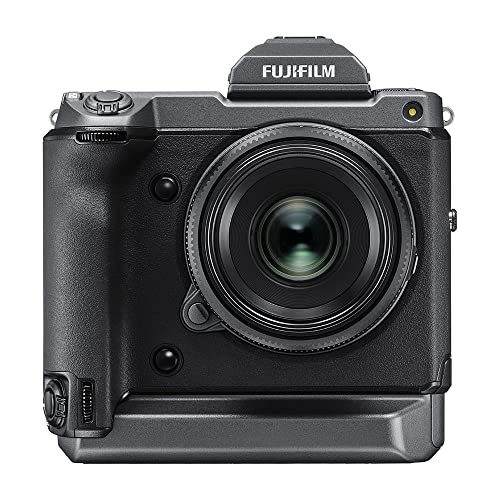
Fujifilm GFX 100 102MP Medium Format Digital Camera (Body Only)
The original Fujifilm GFX 100 is a previous-generation flagship that can make sense if you find it at a lower outlay than the newer models and you value its integrated vertical grip. It pairs a 102-megapixel back-illuminated sensor with the X-Processor 4, delivering 16-bit RAW files, in-body stabilization, and 4K video at 30 frames per second. Weather sealing covers 95 points, and the magnesium alloy body with its built-in grip suits long studio sessions and vertical compositions.
This is a partial fit as a current recommendation: it is an older model with slower autofocus, an older processor, and less effective stabilization than the GFX100S II, and its Amazon listing may reflect limited or third-party stock. Confirm the exact listing, the seller, and the included accessories before buying. It remains a capable camera, but only the right listing makes it a sensible buy today.
Pentax 645Z Medium Format DSLR Camera Body Only
The Pentax 645Z is the oldest camera in this roundup and the most affordable route into a medium format sensor, built around a 51.4-megapixel CMOS sensor in a weather-sealed DSLR body. It offers a tiltable 3.2-inch LCD, dual SD card slots, compatibility with legacy Pentax 645 lenses, and a familiar DSLR control layout that many photographers find reassuring. Its image quality remains strong for landscape and studio work, and the optical viewfinder appeals to photographers who prefer DSLRs over electronic viewfinders.
This is also a partial fit: the 645Z is a previous-generation model with a 27-point autofocus system that struggles with tracking, a 3-frames-per-second burst rate, and no modern subject detection or in-body stabilization. Availability on Amazon may be limited to third-party sellers, so check the listing carefully and confirm what is included. Consider it only if you specifically want a medium format DSLR on a tight budget and you shoot deliberate, slow-paced subjects.
What to Check Before You Buy
First, confirm you are buying the body only or the kit you expect, since GFX100S II bundles with lenses are sold under separate listings. Check the model number 600023616 on the listing so you do not confuse it with the original GFX100S, the GFX100 II, or the rangefinder-style GFX100RF. Second, verify the seller and the warranty terms: authorized dealers provide the manufacturer warranty, while marketplace sellers may not. Third, budget for the system, not just the body. A GF zoom or two primes, spare NP-W235 batteries, fast UHS-II SD cards, and storage for 100-plus-megabyte RAW files add substantially to the total.
Fourth, think about your computer. Files of this size demand a capable processor, plenty of memory, and fast storage for a smooth editing workflow. Fifth, handle the camera if you can. The grip, the viewfinder, and the menu layout are personal, and a short session in a shop tells you more about handling than any specification sheet. Finally, remember that 102 megapixels rewards good technique: a sturdy tripod, careful focus, and quality lenses make the difference between files that look extraordinary and files that simply look large.
FAQ
Is the Fujifilm GFX100S II good for landscape photography?
Yes, it is one of the strongest landscape cameras available. The 102MP sensor captures fine detail, the dynamic range holds highlight and shadow information, the weather sealing suits field work, and the 8-stop stabilization helps handheld shooting at dawn and dusk. Pair it with a wide GF zoom and a tripod for the best results.
How is the GFX100S II different from the original GFX100S?
The GFX100S II uses a newly developed 102MP CMOS II sensor and the X-Processor 5, replacing the older sensor and processor. Stabilization improves to up to 8 stops, autofocus gains AI subject detection down to minus 5.5 EV, and video adds 4K at 30 frames per second with 10-bit colour and external RAW options. The body keeps the same compact 883-gram design.
Does the GFX100S II shoot 8K video?
No. Video tops out at 4K at 30 frames per second internally, with ProRes RAW and Blackmagic RAW available through external recording over HDMI. If you need 8K or 4K at 60 frames per second, the GFX100 II is the model that offers those modes.
What lenses fit the GFX100S II?
It uses the Fujifilm G mount, so native FUJINON GF lenses fit directly. The GF range includes wide-angle, standard, and telephoto primes and zooms, many of them weather sealed. Lenses from other systems can be adapted, but native lenses give the best autofocus and stabilization results.
Is 102 megapixels too much for everyday photography?
It depends on your output. For large prints, heavy cropping, or commercial delivery, the resolution is a genuine asset. For social sharing or small prints, it is more than you need, and the large files slow down storage and editing. The GFX100S II makes the most sense when your work regularly benefits from the extra detail.
Bottom Line
The Fujifilm GFX100S II is the sweet spot of the medium format market: a 102-megapixel sensor, up-to-8-stop stabilization, AI-assisted autofocus, and capable 4K video in an 883-gram weather-sealed body. It is not the fastest camera, nor the best video camera, but for stills photographers who want the finest image quality Fujifilm offers without carrying the flagship, it is the most balanced choice. Choose the GFX100 II if video leads your work, the Hasselblad X2D 100C if colour and craft matter most, and treat the older GFX 100 and Pentax 645Z as budget routes only after confirming the exact listing. For most photographers stepping into medium format, the GFX100S II is where the system makes the most sense.
Disclosure: As an Amazon Associate, we may earn from qualifying purchases.