Our Short List of 3
- Best for: Classic V8 builds running an MSD 6-series box or planning one.
- Maximum voltage: 45,000 volts
- Turns ratio: 100:1
- Primary resistance: 0.7 ohms
- Secondary resistance: 4.5K ohms
- Best for: Four and six cylinder classics on points or an original Ignitor conversion.
- Maximum voltage: 40,000 volts
- Primary resistance: 3.0 ohms
- Secondary resistance: 9.0K ohms
- Turns ratio: 80:1

- Best for: Owners of 2014-2021 GM V8 trucks and SUVs replacing a full set of coils.
- Set contents: 8 coil-on-plug coils, round style
- Fitment: 2014-2021 GM 4.3L, 5.3L, 6.2L and 6.6L V8 engines with round coils
- Replaces OEM numbers: 12621750, 12658183, 12674754, 12699383, 12708496
- Construction: high-temperature epoxy filled, premium copper windings
All 3 Picks at a Glance
| Product | Specs | Action |
|---|---|---|
| MSD Blaster 2 8202 Ignition Coil |
| Check price on Amazon |
| PerTronix Flame-Thrower 40511 Ignition Coil |
| Check price on Amazon |
| Dragon Fire Performance DFC1028-8 Ignition Coil Set |
| Check price on Amazon |
Key takeaways
- Compare high performance ignition coils by output voltage, primary resistance and fitment, from classic canister coils to coil packs for GM V8 engines.
Swapping in a stronger ignition coil sounds simple, but the real decision is matching the coil to the ignition system already on your engine. A low-resistance coil can overheat a points distributor, a high-resistance coil can starve an electronic conversion, and a modern coil-on-plug engine needs an entirely different part. Voltage figures, primary resistance and fitment decide whether the upgrade helps or hurts.
This guide is for three groups: classic-car owners running a distributor, drivers who converted to electronic ignition and want a coil matched to it, and owners of modern V8 trucks with coil-on-plug setups. Every pick below was chosen from the names and specifications printed on its Amazon listing, including maximum voltage, primary resistance and the exact engines named in the fitment notes.
Quick Picks
As an Amazon Associate we earn from qualifying purchases
| Product | Best for | Key spec from title |
|---|---|---|
| MSD Blaster 2 8202 | Distributor engines with an MSD 6-series box | 45,000-volt maximum output |
| PerTronix Flame-Thrower II 45011 | Ignitor II electronic conversions | 45,000 volts, 0.6 ohm primary |
| PerTronix Flame-Thrower 40511 | Four and six cylinder classics | 40,000 volts, 3.0 ohm primary |
| Dragon Fire Performance DFC1028-8 | 2014-2021 GM V8 trucks and SUVs | Full set of eight round coils |
How to Choose
Match Primary Resistance to Your Ignition System
Primary resistance is the single most important number on a canister coil listing, because it controls how much current flows through the coil and the switching device. Points distributors and early electronic conversions generally need a coil in the 1.5 to 3.0 ohm range, while performance modules such as the Ignitor II are built for a much lower 0.6 ohm coil. Fit a low-resistance coil to points and the contacts burn quickly; fit a high-resistance coil to a performance module and spark energy falls. Read the resistance figure in the listing title or specification table before anything else.
Read the Voltage Figure the Right Way
Listings headline maximum voltage, from 40,000 volts on classic canister coils to 45,000 volts on hotter performance versions. That figure is a ceiling, not a constant output: the coil only produces the voltage the spark gap demands at that moment. A higher ceiling matters when you run wider plug gaps, higher compression or forced induction, because the spark has to jump a harder gap. On a mild stock engine, a 40,000-volt coil and a 45,000-volt coil behave much the same, so treat voltage as a headroom check rather than the deciding factor.
Pick the Coil Architecture Your Engine Actually Uses
Older engines use one canister coil feeding a distributor, while modern engines use a coil pack or one coil per cylinder that plugs straight onto each spark plug. The two families never interchange. Canister buyers choose between oil-filled housings, which need upright mounting, and epoxy-filled housings that tolerate vibration and angled mounting. Coil-on-plug buyers must match the connector shape and the exact OEM part numbers their engine left the factory with, because visually similar coils for the same brand often carry different plugs and mounting ears.
Confirm Fitment and Mounting Before You Order
Universal canister coils still need the right bracket diameter, tower style and terminal layout, and the listing will say whether a ballast resistor is required with points. For coil packs, work from the OEM numbers printed in the listing and compare them with the numbers on your old coils, then confirm the model years and engine sizes in the fitment list. Also check whether the set covers every cylinder; V8 packs are sold as full sets of eight, and mixing one new coil with seven tired ones rarely cures a misfire for long.
The 4 Best Options
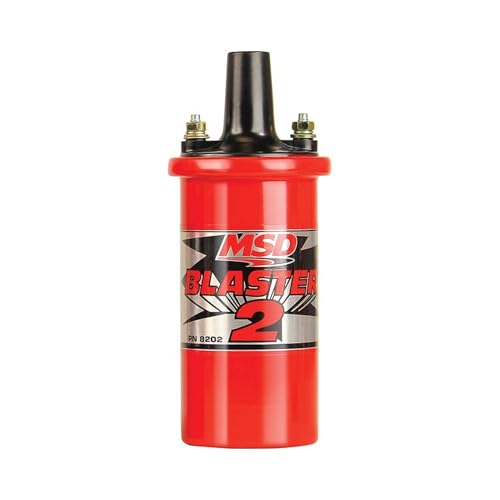
MSD Blaster 2 8202 Ignition Coil
- Best for: Classic V8 builds running an MSD 6-series box or planning one.
- Maximum voltage: 45,000 volts
- Turns ratio: 100:1
- Primary resistance: 0.7 ohms
- Secondary resistance: 4.5K ohms
Classic V8 builds running an MSD 6-series box or planning one.
The oil-filled housing should be mounted upright, and points systems need the ballast resistor the listing calls for.
The Blaster 2 is the default upgrade for a distributor engine that already runs, or will soon run, an MSD 6-series ignition box. Its listing leads with a 45,000-volt ceiling and a 100:1 turns ratio, numbers aimed at engines with wider plug gaps and higher cylinder pressure than stock. The oil-filled canister drops into most factory coil mounts, and MSD also rates it for electronic ignitions and for points systems when a ballast resistor is fitted. It suits classic V8 street builds that want a documented, widely supported coil.
PerTronix Flame-Thrower II 45011 Ignition Coil
PerTronix built the Flame-Thrower II around its Ignitor II electronic conversion, and the listing states the pairing plainly: a 0.6 ohm primary resistance with output up to 45,000 volts. That low resistance is exactly what the Ignitor II module is designed to switch, so the two parts work as a matched set instead of a guess. The oil-filled canister keeps the traditional round shape and black finish, which suits engine bays where a stock appearance matters. It is a 12-volt coil aimed at converted classics rather than points cars.
Specs
- Maximum voltage: 45,000 volts
- Primary resistance: 0.6 ohms
- Construction: oil-filled canister, black finish
- System voltage: 12 volts
- Designed for: Ignitor II electronic ignition conversion kits and Plug n’ Play distributors
- Item weight: 1.52 pounds
Best for: Classic cars converted to Ignitor II electronic ignition.
Watch out for: The 0.6 ohm primary is too low for breaker points and for the original Ignitor module, so confirm which module your distributor carries.
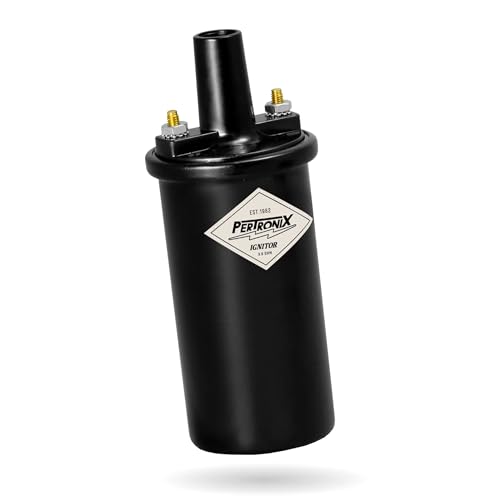
PerTronix Flame-Thrower 40511 Ignition Coil
- Best for: Four and six cylinder classics on points or an original Ignitor conversion.
- Maximum voltage: 40,000 volts
- Primary resistance: 3.0 ohms
- Secondary resistance: 9.0K ohms
- Turns ratio: 80:1
Four and six cylinder classics on points or an original Ignitor conversion.
V8 applications call for the 1.5 ohm version instead, so do not swap this coil into an eight cylinder car.
The 40511 is the Flame-Thrower variant PerTronix assigns to four and six cylinder engines, and its listing centers on a 3.0 ohm primary resistance with 40,000-volt output. That higher resistance protects points and the original Ignitor module in smaller engines, which draw less current through the coil than a V8 setup. The black oil-filled canister keeps the factory look, and the application chart ties this resistance value to 12-volt four and six cylinder systems. It is the pick when the car is staying close to stock but the original coil is weak or leaking.
Dragon Fire Performance DFC1028-8 Ignition Coil Set
- Best for: Owners of 2014-2021 GM V8 trucks and SUVs replacing a full set of coils.
- Set contents: 8 coil-on-plug coils, round style
- Fitment: 2014-2021 GM 4.3L, 5.3L, 6.2L and 6.6L V8 engines with round coils
- Replaces OEM numbers: 12621750, 12658183, 12674754, 12699383, 12708496
- Construction: high-temperature epoxy filled, premium copper windings
Owners of 2014-2021 GM V8 trucks and SUVs replacing a full set of coils.
GM used both round and square coil bodies in these years, so confirm the shape and OEM numbers on your engine before ordering.
Modern GM V8s skip the distributor entirely, and this set of eight coil-on-plug units is built for the 2014 to 2021 Gen V LT engines in Silverado, Tahoe, Camaro, Corvette and Escalade applications. The listing describes high-temperature epoxy filling to guard against voltage leaks, premium copper windings, and weatherproof connectors molded for a direct plug-in fit. It replaces a long list of factory part numbers, which makes cross-checking your old coils straightforward. Replacing all eight at once also keeps spark energy even across both banks on a high-mileage truck.
Which One Fits Your Situation
Your Classic V8 Still Runs on Points
Stay with a coil whose resistance the points can survive, and add the ballast resistor the maker specifies. The MSD Blaster 2 works in this role when paired with that resistor, and its 45,000-volt ceiling leaves room if you later fit an MSD box. Avoid the 0.6 ohm Flame-Thrower II here, because that resistance level is meant for an electronic module, not contact points.
You Converted a Four or Six Cylinder Car to Electronic Ignition
The PerTronix 40511 matches the 3.0 ohm requirement that the maker publishes for four and six cylinder Ignitor conversions, and its 40,000-volt output is a healthy step over a tired original coil. It keeps the stock black canister look, so the engine bay still reads as period correct after the swap.
Your Street Build Runs an MSD 6-Series Box
The Blaster 2 was designed alongside that ignition family, with a 100:1 turns ratio, 140 mA peak current and a 350 uS spark duration listed in its specifications. It mounts in most factory canister brackets, which keeps the install simple, and the same coil also covers a later move from points to an electronic trigger.
Your Late-Model GM Truck Has a Misfire
On a 2014 to 2021 Silverado, Tahoe or Yukon, the Dragon Fire Performance set replaces all eight round-style coils in one job and cross-references the factory numbers printed on your originals. Match the OEM numbers first, since square-body coils from the same years look similar but use a different housing.
Common Mistakes
- Buying a coil by voltage alone and ignoring primary resistance, which is the figure that decides compatibility with points or an electronic module.
- Fitting a low-resistance performance coil to a points distributor without a ballast resistor, then blaming the coil when the points burn.
- Mounting an oil-filled canister coil on its side, which can uncover the windings and shorten its life.
- Replacing a single coil-on-plug unit on a high-mileage engine while the remaining originals are near the end of their service life.
- Skipping the fitment check on coil packs and ordering by vehicle name only, when the listing keys fit to specific OEM part numbers.
Frequently Asked Questions
Will a high performance coil add power to a stock engine?
On a healthy stock engine, expect little change you can feel. The coil only has to fire the mixture cleanly, and a standard coil already does that at stock plug gaps. The gains show up when the original coil is weak, or when wider gaps, higher compression or boost ask for more voltage than the factory part can supply.
Can I run a 0.6 ohm coil with breaker points?
No. A primary resistance that low draws more current than contact points are built to switch, so the points pit and burn in short order. Points systems belong with coils in the 1.5 to 3.0 ohm range, often with a ballast resistor in the circuit. Save the 0.6 ohm coils for the electronic modules they were designed around.
Should I widen the spark plug gap with a stronger coil?
A higher voltage ceiling gives you the option, and the makers of these coils describe larger gaps as one of the reasons to upgrade. Widen the gap in small steps and only within the range your engine builder or plug maker suggests, because an excessive gap raises the voltage demand at high load and can expose weak plug wires.
Is one coil enough for a coil-on-plug engine, or should I buy the set?
One coil cures one dead cylinder, and that is a reasonable repair on a low-mileage engine. On an older truck, the remaining coils have the same age and heat exposure, so a full matched set such as the eight-piece Dragon Fire Performance pack avoids repeating the same job cylinder by cylinder over the following months.