Key takeaways
- Compare tower HEPA air purifiers with washable prefilters from Winix and TruSens, with True HEPA grades, CADR figures, and room sizes published by each maker.
As an Amazon Associate, we earn from qualifying purchases made through links on this page.

A tower purifier saves floor space, but the two qualifiers in this roundup cut the field down fast. The first is a real HEPA stage, published by the maker as True HEPA rather than a vague HEPA-type label. The second is a prefilter you can rinse with water and reuse, not a charcoal sheet that goes in the bin every few months and not a mesh layer bonded inside a sealed drum that can only be vacuumed. Many familiar tower models fail the second test: some pair their HEPA filter with a replaceable carbon prefilter, and some hide the mesh inside an all-in-one cartridge that the maker says must never get wet. Four models pass both tests on their makers’ own documentation, and they are the only four in this guide.
Three of the four come from Winix, which uses a separate washable fine mesh prefilter across its upright range, and the fourth is the TruSens Z-3000, a cylindrical tower with a washable prefilter layer in its 360-degree drum. Every figure below comes from the manufacturer’s own product page or specification sheet, and each section notes where a maker’s published data stops. All four machines add a carbon stage for odours and one extra feature, PlasmaWave ionization on the Winix models and a UV-C lamp on the TruSens, and on all four that extra feature can be switched off.
What to look for
Read the HEPA label the way the maker prints it. True HEPA is the grade to look for in this category, and each maker states the particle size and capture figure behind its claim. Winix publishes its True HEPA stage at 99.99 percent of particles at 0.1 to 0.3 microns on the 5510 and 5520, and down to 0.003 microns on the 9800. TruSens fits a DuPont True HEPA drum published at 99.97 percent of particles down to 0.3 microns. A purifier described only as HEPA-type, or with no grade printed at all, is a different product from the ones gathered here.
Confirm the prefilter is washable, not just cleanable. A washable prefilter is a separate mesh layer that you remove, rinse under running water, let dry fully, and refit. That is how Winix describes the fine mesh prefilter on the 5510, 5520, and 9800, and TruSens prints a washing routine for the Z-3000 prefilter in its manual. Vacuuming or brushing a mesh is not the same thing, and neither is a carbon prefilter sheet: carbon sheets absorb odours until they saturate, and washing does not restore them, so makers treat them as replaceable parts.
Match CADR and room size to your room, using the maker’s own basis. CADR is published in cubic feet per minute, and the AHAM Verifide room size that Winix prints is the room area the machine can clean at 4.8 air changes per hour. The much larger maximum coverage figure on the same page assumes roughly one air change per hour, a gentler clean that suits odour control in a big open space. For a bedroom or a main living room, size the machine by the AHAM figure first: 392 square feet for the 5510 and 5520, 522 square feet for the 9800, and a CADR of 191 cubic feet per minute for the Z-3000, converted from the 325.5 cubic metres per hour on its specification sheet.
Budget attention for the carbon stage, because it ages faster than the HEPA stage. On the 5510 and 5520 the carbon element sits inside the combined Filter Q cartridge that Winix says to replace about once a year. On the 9800 the activated carbon filter has a published life of three months, far shorter than its twelve-month HEPA filter, and on the Z-3000 the carbon filter is a separate part with a published life of three to four months. The washable prefilter removes the most frequent small purchase from the routine, but it does not remove filter costs altogether.
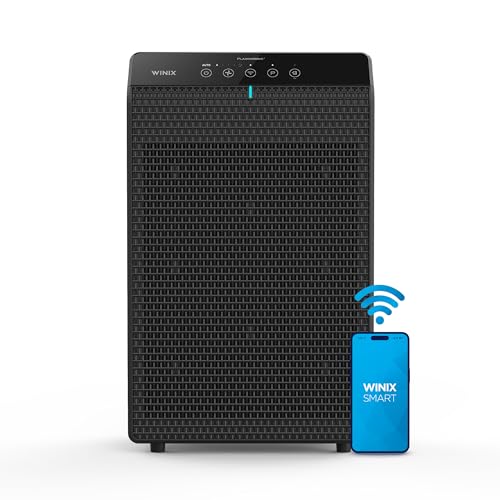
Check the tower footprint and where the machine breathes. The 5520 is the narrowest upright here at 13.59 by 8.27 inches, the 9800 is the widest at 16.5 by 11.8 inches, and the Z-3000 draws air in through a full 360-degree drum, so it can sit away from a wall without a dead side. Height matters near low furniture: the Z-3000 stands 28.6 inches tall, the 9800 is 23.2 inches, and the 5520 is 22.17 inches.
Decide how much automation you want. All three Winix models carry dual smart sensors, an air quality indicator, an auto mode that follows the sensor reading, and a light-sensing sleep mode, plus app control over Wi-Fi. The Z-3000 takes a different route with its SensorPod, a separate room sensor that reports air quality from across the room and drives auto mode from that reading, so the machine reacts to the air where you sit rather than the air in the corner.
Winix 5510
The 5510 is Winix’s current mid-size upright, rebuilt around app control. Its four-stage path runs air through a washable fine mesh prefilter, an advanced odour control carbon filter built with carbon pellets, a True HEPA filter, and the PlasmaWave stage. Winix publishes the True HEPA stage at 99.99 percent of particles at 0.1 to 0.3 microns, tested to the IEST-RP-CC0007 standard it cites on the product page. The AHAM Verifide room size is 392 square feet at 4.8 air changes per hour, with a maximum coverage of 1,882 square feet in one hour, and Winix’s AHAM listing puts dust CADR at 252 cubic feet per minute.
Day-to-day running is mostly hands-off. Dual smart sensors feed a colour air quality indicator, auto mode follows the sensor, and sleep mode engages on its own when the room darkens. The Winix Smart App handles remote control and scheduling over Wi-Fi, and a filter replacement indicator tells you when the combined Filter Q cartridge, which bundles the carbon and True HEPA stages, reaches the end of its roughly twelve-month life. Washing the mesh prefilter on a regular cycle keeps pet hair and coarse dust out of that cartridge, which is where the washable qualifier earns its keep in a home with animals.
Best for: households with pets in rooms up to about 390 square feet that want pellet carbon for cooking and litter odours, app control, and a prefilter they can rinse instead of replacing.
Spec-based limitations: the carbon stage is not separable from the HEPA stage, so both are replaced together in the Filter Q cartridge even if only one is spent. PlasmaWave is an ionization stage; Winix publishes an eight-hour ozone figure of 0.22 parts per billion by volume for this model, and the stage can be turned off. Winix does not print a minimum noise figure on the product page we read, so low-speed quietness cannot be compared from maker data alone.
Winix 5520
The 5520 shares its filtration platform with the 5510 and repackages it in a shorter, narrower body, 13.59 by 8.27 by 22.17 inches and 13.3 pounds, which suits it to tighter floor plans and lower sight lines. The stage order is the same: washable fine mesh prefilter first, then the advanced odour control carbon filter, then the True HEPA filter published at 99.99 percent of particles at 0.1 to 0.3 microns, then PlasmaWave. Winix publishes full CADR figures for this model: 252 cubic feet per minute for dust, 247 for pollen, and 253 for smoke, with the same AHAM Verifide room size of 392 square feet and the same maximum coverage of 1,882 square feet in one hour as the 5510.
Controls run to five fan speeds, with dual smart sensors, a three-colour air quality indicator, auto mode, and the same light-triggered sleep behaviour as its sibling. Wi-Fi and Alexa support are built in, the app carries the timer function, and the filter replacement indicator tracks the Filter Q cartridge. The washable prefilter routine is identical to the 5510: pull the mesh, rinse it, dry it fully, and refit it.
Best for: smaller living rooms, large bedrooms, and open studio layouts where the 5510’s taller body is awkward, but the same CADR, the same True HEPA grade, and the same washable prefilter are wanted.
Spec-based limitations: published CADR matches the 5510, so the smaller body buys placement flexibility rather than extra cleaning power, and rooms beyond the 392-square-foot AHAM figure get fewer air changes per hour than the headline maximum coverage suggests. The carbon and HEPA stages again arrive as one combined cartridge on a roughly twelve-month cycle, and the three-colour indicator gives a band, not a numeric particle count.
Winix 9800
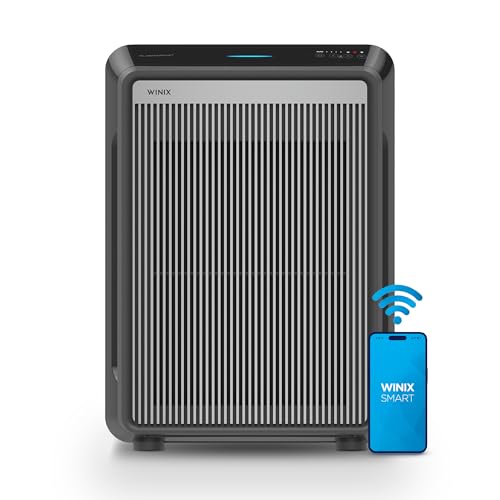
The 9800 is the largest machine in this guide, for rooms that outgrow the 392-square-foot class. Winix publishes an AHAM Verifide room size of 522 square feet and a maximum coverage of 2,506 square feet in one hour. The body is correspondingly bigger at 16.5 by 11.8 by 23.2 inches and 18.7 pounds. Filtration is again four stages: a washable fine mesh prefilter, an activated carbon filter, a True HEPA filter that Winix publishes at 99.99 percent of airborne allergens down to 0.003 microns, and PlasmaWave. One gap is worth naming directly: Winix does not publish a CADR figure on the 9800 product page we read, so its sizing here rests on the AHAM room size.
The feature set follows the same pattern as the smaller Winix models, with dual smart sensors, auto mode, automatic sleep mode when the room darkens, Wi-Fi with Alexa support, and a filter replacement indicator. Winix publishes a minimum noise level of 26.2 decibels, the only maker-published low-speed noise figure in this guide, which gives the 9800 a documented case for bedroom use despite its size.
Best for: large living rooms and open-plan spaces up to the 522-square-foot AHAM figure, and for buyers who want the biggest washable-prefilter tower in the Winix line with a published low-speed noise figure for overnight running.
Spec-based limitations: the activated carbon filter has a published life of only three months, the shortest interval in this guide, so odour control depends on a part that needs frequent attention even though the prefilter is washable and the HEPA stage lasts a year. The footprint is the widest here, and at 18.7 pounds it is the least convenient to carry between rooms. The missing published CADR figure also means cross-brand CADR comparisons cannot be completed from Winix data alone.
TruSens Z-3000

See the TruSens Z-3000 on Amazon
The Z-3000 is the different design in this group: a cylindrical tower, 10.4 by 10.4 by 28.6 inches and about 12.6 pounds, that pulls air in through a 360-degree drum and pushes it out in two directions under TruSens’s PureDirect approach. The drum is a three-layer part built around a washable prefilter that peels away from the drum for rinsing, a carbon filter, and a DuPont True HEPA filter published at 99.97 percent of particles down to 0.3 microns, with a UV-C lamp inside the drum. The manufacturer’s specification sheet lists CADR at 325.5 cubic metres per hour, about 191 cubic feet per minute, and coverage of about 750 square feet at two air changes per hour.
Its signature part is the SensorPod, a separate air quality monitor that sits across the room and reports particle levels back to the purifier, so auto mode responds to the air at your seat rather than at the machine. Fan settings run from a whisper setting through three speeds to turbo, the published noise range is 32 to 66 decibels, and power draw is 68 watts. Filter intervals are printed plainly in the specification sheet: the HEPA drum lasts twelve to fifteen months and the carbon filter three to four months, while the prefilter is washed rather than replaced.
Best for: larger rooms where a corner-placed, front-intake tower would read the wrong air, and for buyers who like the idea of the sensor living where the people are, with a washable prefilter wrapped into a single drum change.
Spec-based limitations: CADR is the lowest in this guide, so in a big room the Z-3000 completes fewer air changes per hour than the Winix models despite its generous two-changes-per-hour coverage figure, and the two bases are not directly comparable. The carbon filter’s three-to-four-month life is a recurring part on top of the drum, and the UV-C lamp is a further replaceable part with its own two-to-three-year interval. The published noise ceiling of 66 decibels on turbo is high, so overnight use belongs on the whisper and low settings.
Comparison table
| Model | HEPA grade as published | Prefilter | AHAM or maker room size | Maximum coverage | Main filter life |
|---|---|---|---|---|---|
| Winix 5510 | True HEPA, 99.99 percent at 0.1 to 0.3 microns | Washable fine mesh | 392 sq ft (AHAM) | 1,882 sq ft in 1 hour | About 12 months (Filter Q) |
| Winix 5520 | True HEPA, 99.99 percent at 0.1 to 0.3 microns | Washable fine mesh | 392 sq ft (AHAM) | 1,882 sq ft in 1 hour | About 12 months (Filter Q) |
| Winix 9800 | True HEPA, 99.99 percent down to 0.003 microns | Washable fine mesh | 522 sq ft (AHAM) | 2,506 sq ft in 1 hour | 12 months (HEPA); carbon 3 months |
| TruSens Z-3000 | DuPont True HEPA, 99.97 percent down to 0.3 microns | Washable, peels from drum | About 750 sq ft at 2 changes per hour | Not published on that basis | 12 to 15 months (drum); carbon 3 to 4 months |
Frequently asked questions
Can I wash the carbon prefilter on a tower purifier too?
No. On the models here the washable part is the mesh prefilter only. Carbon stages are consumable: they absorb odours until they saturate, and rinsing does not restore that capacity, which is why each maker publishes a replacement interval for the carbon element.
How often does a washable prefilter need rinsing?
Makers frame it as a regular short cycle rather than a fixed date, and homes with pets or visible dust need it more often. Remove the mesh, rinse it under running water, let it dry completely, and refit it. Running the machine with a damp prefilter is a mistake, because moisture at the intake works against the dry filter media behind it.
Is the biggest coverage number the right one for sizing a bedroom?
No. The maximum coverage figures here assume about one air change per hour. The AHAM Verifide room sizes, 392 square feet for the 5510 and 5520 and 522 square feet for the 9800, assume 4.8 air changes per hour and are the safer basis for a room you sleep in.
Should the PlasmaWave or UV-C stage decide my choice?
Treat it as a secondary feature. Both are add-on stages behind a True HEPA filter, both can be switched off on these models, and the core job of particle capture belongs to the HEPA stage and the washable prefilter in front of it. Choose on CADR, room size, and filter intervals first.
Conclusion
The washable prefilter qualifier is doing real work in this category: it removes the most common tower designs, including several well-known models whose prefilters are replaceable carbon sheets or sealed drum layers, and leaves a short list. Within that list, the Winix 5520 is the flexible pick for ordinary rooms, the 5510 matches it on published cleaning figures with a taller body, and the 9800 steps up to a 522-square-foot AHAM room size at the cost of a three-month carbon interval. The TruSens Z-3000 is the alternative shape and the alternative sensing idea, with the lowest CADR here but a room sensor that sits where you do. Pick by the room size that matches your space, then check the carbon interval you are willing to live with.