
Key takeaways
- Pro: Cable-style families are typically lighter than heavy link chains, which makes storage and handling easier.
- Pro: A coded model name lets you match it to a fitment chart rather than guessing.
- Con: Cable designs usually wear faster and bite less on deep ice than heavier link chains.
The sign at the base of a mountain pass flashes “chains required,” traffic slows to a crawl, and drivers start pulling over to wrestle with tangled links in the slush. Anyone who has watched that scene knows the lesson: chains belong in the trunk before the storm, and they should be practiced once in a dry driveway, not for the first time at dusk on a shoulder.
This guide compares six chain and traction-device names that drivers commonly consider. It covers how to size them, what to check against your vehicle manual, and the trade-offs that follow from the product names alone. Rules about chain use vary by state, so always check local regulations for the route you plan to drive. Fitment charts get updated, so use this 2026 list as a starting point and check the current chart for your tire.
Quick Picks
| Product | Best for | Worth knowing |
|---|---|---|
| Security Chain Company SZ143 Super Z6 | Passenger cars and crossovers | Super Z6 names a cable-style family |
| Peerless Auto-Trac | Drivers wanting a self-tensioning style | Auto in the name points to an automatic design |
| Thule CB-12 | Drivers wanting a compact travel option | Made by a brand known for racks and gear |
| Konig K-Summit | Drivers wanting a quick-mount design | K-Summit is the model line |
| Glacier Twist Link | Light trucks and larger vehicles | Twist Link names a link-chain style |
| Security Chain Company Quik Grip | Drivers who want a simple fitting process | Quik in the name points to fast installation |
How to Choose
Confirm that chains fit your vehicle’s clearance
Many modern cars have tight wheel-well clearance, and some manuals ban traditional chains and allow only cable-type or “S-class” low-profile designs. Check the owner manual under the winter driving section, then compare the clearance class in the product description. A good rule of thumb is to ignore any chain whose class is not listed as compatible with your vehicle, because a chain that rubs the fender or brake line can cause real damage. If the manual is silent, ask a dealer service department, because they know which classes have been approved for each model year.
Match the chain to your exact tire size
Chains are sold by tire size code, such as 205/65R16, printed on the sidewall. Look up that code in the manufacturer fitment chart before ordering, and never rely on rough width alone. If you run larger tires or mix summer and winter sets, buy chains for the set you will be driving in snow so the fit is snug and does not slap against the sidewall. Take a photo of the sidewall before shopping so you have the exact code at hand, and recheck it if you ever change wheels or tires.
Choose between cable, link, and automatic designs
Cable chains are lighter and quieter and suit clearance-limited cars, while link chains cut deeper into ice and suit heavier vehicles or steep routes. Self-tensioning designs tighten on their own after you drive a short distance, which helps reduce roadside adjustments. If you drive through snowy regions rarely, ease of installation is often worth more than maximum bite. Self-tensioning designs cost more but save the awkward second stop to retighten, while basic link chains are cheapest and need regular adjustment.
Plan for drive wheels and speed limits
Chains normally go on the drive wheels, which are the front tires on front-wheel-drive vehicles and the rear on rear-wheel-drive ones. All-wheel-drive owners should follow the manual, since some require chains on all four wheels or a specific axle. Most chains are rated for low speeds, often around 25 to 30 miles per hour, so slow down and remove them when you reach clear pavement. Rehearse the installation in daylight at home, with the parking brake set, so you know where each hook and fastener goes before you need them.
Our Picks Reviewed
Security Chain Company SZ143 Super Z6
The Super Z6 name places this in a cable-style family from Security Chain Company, and the SZ143 code suggests a specific fitment class. It targets drivers who need a low-profile design. Owners with low-clearance cars will want to read the clearance notes closely, because that is the main reason people pick this style over heavier chains.
- Pro: Cable-style families are typically lighter than heavy link chains, which makes storage and handling easier.
- Pro: A coded model name lets you match it to a fitment chart rather than guessing.
- Con: Cable designs usually wear faster and bite less on deep ice than heavier link chains.
Skip it if you regularly drive steep, icy grades or haul heavy loads, where link chains grip better. Check the sizing chart carefully, because the code only works if your tire size is listed. Practice mounting it once at home before relying on it in a storm. Keep the instructions in the glove box.
Peerless Auto-Trac
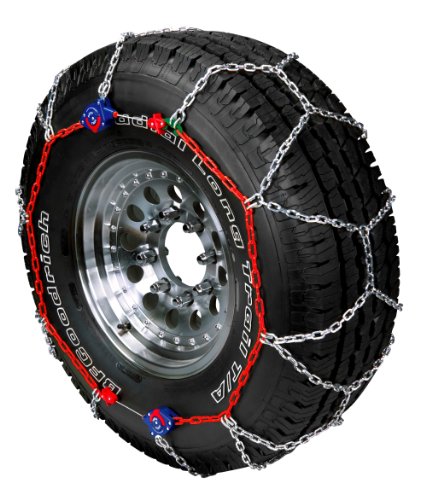
SCC Peerless 0232605 Auto-Trac Light Truck/SUV Tire Traction Chain - Set of 2


As an Amazon Associate we earn from qualifying purchases. Product prices and availability are accurate as of the date/time indicated.
The Auto in the name points to a self-adjusting design that tightens as you drive. Peerless is a long-established chain brand, so it makes a natural shortlist item. The appeal is less stress at the roadside, which matters most when temperatures are low, light is fading, and traffic is moving close by.
- Pro: Self-tensioning designs can save time because they need fewer manual adjustments after the first few yards.
- Pro: A familiar brand means sizing charts and replacement parts are easy to find.
- Con: Convenience features can add cost, and mechanical tensioners can fail if packed away wet.
Skip it if you only need an emergency set for rare use and prefer the lowest-cost option. Also pass if your vehicle manual forbids traditional chains, since clearance rules apply regardless of how easy the product is to install. Dry it fully before storage.
Thule CB-12
Thule is better known for racks and carriers, and the CB-12 name suggests a compact design from a brand that cares about travel convenience and tidy storage. Think of it as a carry-along set for trips rather than a daily winter tool, which fits families that visit snow country a few times a season.
- Pro: A compact format suits owners with small trunks or crossovers who carry gear for ski trips.
- Pro: A brand focused on travel accessories tends to emphasize easy mounting and carry cases.
- Con: Compact designs may not suit heavy-duty uses, such as long climbs on thick ice with a loaded vehicle.
Skip it if your vehicle is a heavy pickup or a work truck that needs sturdier link chains. Verify your tire size against the fitment list, since compact designs often cover a narrower range of sizes than general-purpose chains. Check the case size for your trunk.
Konig K-Summit
The K-Summit name signals a mountain-ready model from Konig, a brand common in European winter driving, and it is usually associated with quick installation. Drivers who have struggled with chains before often value any design that cuts the time spent kneeling in slush beside the car.
- Pro: A design built around fast mounting helps drivers who dread working in freezing conditions.
- Pro: Brands with European winter experience often target low-clearance vehicles.
- Con: Fast-mount designs can cost more than basic link chains, and parts are less common in some stores.
Skip it if you prefer shopping at local auto parts chains where brand selection is limited. Also pass if you only need chains once every few winters and want a basic set for the glove box emergency kit. Read reviews for your tire size.
Glacier Twist Link
Twist Link points to a link-chain style, which typically puts more steel in contact with the ground than cable designs and suits larger vehicles. Its link construction is the classic approach for owners who prize durability and plan to use the set season after season on rough winter roads.
- Pro: Link chains are generally the stronger choice for ice and steep grades, particularly on heavier vehicles.
- Pro: A traditional style is often simpler to repair, and individual links can be replaced.
- Con: Link chains are heavier, noisier, and may not fit vehicles with tight wheel clearance.
Skip it if your car has low clearance or a manual that restricts traditional chains. Also pass if you want a lightweight set to store easily in a small trunk with groceries and luggage. Expect to store it in a sturdy bin.
Security Chain Company Quik Grip

Security Chain Company QG3210CAM Quik Grip Wide Base Type CAM-DH Light Truck Tire Traction Chain - Set of 2
As an Amazon Associate we earn from qualifying purchases. Product prices and availability are accurate as of the date/time indicated.
The name emphasizes a quick fitting, which helps first-time chain users who worry about wrestling with a tangle in cold weather. For a first set, that simplicity is a real advantage, because confidence in mounting matters as much as raw traction when conditions turn bad.
- Pro: A simpler installation process reduces the chance of a mistake that damages the chain or the vehicle.
- Pro: A familiar brand name helps with finding size charts and replacement parts.
- Con: Ease of mounting may come at the expense of the bite that a heavier chain offers on deep ice.
Skip it if your commute includes steep icy hills every day, since a heavier-duty setup will probably serve you better. Check your vehicle clearance before ordering, and keep a pair of gloves and a mat with the chains for roadside use. Bring a tarp or mat for kneeling.
Which One Fits
- Compact car or crossover with tight clearance: Security Chain Company SZ143 Super Z6 or Konig K-Summit.
- Driver who dreads roadside fiddling: Peerless Auto-Trac or Security Chain Company Quik Grip.
- Ski-trip traveler with limited trunk space: Thule CB-12.
- Pickup or heavier vehicle on steep roads: Glacier Twist Link, after confirming clearance.
- Off-road enthusiast who also runs aggressive rubber: pair chains with the options in our mud terrain tire guide.
Common Mistakes
- Buying chains without checking the tire size code against the fitment chart.
- Waiting until the storm to unbox chains for the first time.
- Putting chains on the wrong axle instead of the drive wheels.
- Driving too fast with chains installed, which can break links and damage the vehicle.
- Leaving chains on dry pavement, where they wear quickly and can harm the road surface.
FAQ
Do I need chains if I have all-wheel drive?
All-wheel drive helps with acceleration but not with stopping. Some jurisdictions still require chains in severe conditions, so carry a set that your manual permits. Many mountain regions post chain requirements that apply regardless of drivetrain, so the label on the vehicle does not exempt you.
Can I use tire chains on any tire?
Only if the chain is sized for that tire and your vehicle has enough clearance. Always check the manual, and compare options if you also plan to upgrade rubber, such as in the tires for Hyundai Tucson guide.
How do I store chains?
Dry them off after use, rinse off road salt, and keep them in the supplied bag. Moisture trapped in a bag shortens the life of steel parts. Check the links or cables for bent or broken parts at the start of every season, and replace damaged pieces rather than hoping they hold.
Are chains better than snow tires?
They solve different problems. Winter tires help all season, while chains are a temporary add-on for extreme conditions. A mix of both is common in mountain regions. Chains deliver the strongest traction on packed snow and ice, but they are slow and temporary, so they are no replacement for a good set of winter tires.
Should I carry chains even with all-terrain tires?
Yes, in regions with chain controls. See the all terrain tires roundup for traction tires, but remember that rules can still require chains on passes.


