Key takeaways
- Four balanced Class-D power amplifiers for vinyl listening, from compact desktop amps to rack-ready power, compared to match your turntable setup and room.
A turntable only sounds as good as the amplifier driving the speakers, and a balanced Class-D power amplifier is a practical way to put clean, quiet power into a vinyl setup without a large, hot chassis. Balanced XLR inputs reject the hum and interference that long unbalanced cable runs can pick up, which matters for the low-level signal from a phono stage. The four amplifiers in this guide all accept balanced inputs, all use Class-D output stages, and all were picked from current Amazon listings for people who play records at home.
This guide is for vinyl listeners who already own a turntable and a phono stage, or a receiver with a phono input, and now need a dedicated power amplifier to drive passive speakers. The picks range from a compact desktop amplifier that sits beside a turntable to rack-ready units with enough power for large rooms, and every specification in the product sections below comes from the Amazon listing itself rather than a review or a roundup.
Quick Picks
As an Amazon Associate we earn from qualifying purchases
| Product | Best for | Key spec from title |
|---|---|---|
| Fosi Audio ZA3 | A compact desktop vinyl setup | 190W x2 with XLR and RCA inputs |
| Fosi Audio V3 Mono | A dedicated monoblock pair | 240W monoblock with balanced inputs |
| Crown XLS1502 | Large speakers in a big room | 525W per channel at 4 ohms |
| Rockville D12 | A rack setup with pro speakers | 1400W RMS at 4 ohms |
How to Choose
Balanced Inputs and Why They Matter for Vinyl
Vinyl starts as a tiny signal. A phono cartridge produces only a few millivolts, so any hum or interference picked up on the way to the amplifier is amplified along with the music. Balanced XLR connections send the signal twice, once inverted, and the receiving end cancels out noise that both wires picked up. That is why balanced inputs are standard in studios and worth having at home when the amplifier sits far from the phono stage, when cables run past power supplies or routers, or when a turntable setup shares a room with a computer. For a short run on a quiet desk, RCA works fine, but XLR gives the signal a cleaner path when the run gets longer.
Power Ratings: RMS, Peak, and Your Speakers
Amplifier power is quoted in several ways, and the label that matters most for home listening is watts per channel into a stated impedance, usually 8 or 4 ohms. RMS figures describe continuous power, while peak figures describe short bursts and are always larger, so a 5000W peak rating can sit beside a 1400W RMS rating on the same amplifier. Match the amplifier to your speakers by checking the speaker impedance and sensitivity: efficient speakers need less power to play loud, while low-sensitivity speakers in a large room need more. An amplifier with comfortable headroom plays cleanly at normal volumes, whereas an underpowered one clips and can damage tweeters.
Class-D Sound, Heat, and the Rest of the Chain
Class-D amplifiers switch their output devices on and off at high speed, which makes them far more efficient than traditional linear designs and keeps the chassis cool even during long listening sessions. That efficiency is why a compact Class-D amplifier can deliver serious power from a small box with a modest external supply. What matters for vinyl is the rest of the chain: the phono stage sets the noise floor, the speakers set the character, and the amplifier mostly needs to stay out of the way. Look for low distortion figures and a high signal-to-noise ratio on the listing, and remember that a subwoofer output is useful if your main speakers are small.
Size, Rack Space, and Everyday Practicalities
A power amplifier has to live somewhere, and the right size depends on the room. A compact desktop amplifier fits on a shelf beside a turntable and needs only a power outlet and a pair of speaker cables, which suits a small listening corner. A rack amplifier takes a standard 19-inch slot and is built to sit in a stack with other gear, which suits a dedicated media room or a home studio. Bridged mode turns a two-channel amplifier into a single more powerful channel, but it changes the impedance the amplifier sees, so check the listing before bridging. Monoblocks are a third option: one box per channel, which means buying two for stereo.
The 4 Best Options
Fosi Audio ZA3

The ZA3 is the most straightforward pick in this guide: a compact stereo amplifier that puts balanced XLR inputs within reach of a desktop vinyl setup. Its TPA3255 Class-D stage delivers 190 watts per channel in stereo, or 300 watts as a single channel, with a 48-volt 5-amp adapter in the box. Distortion stays below 0.006 percent and the signal-to-noise ratio is at least 106 dB on the listing, which suits quiet passages on records. A subwoofer output lets small main speakers hand off the low end, and the 2 to 8 ohm range covers most bookshelf and floorstanding pairs.
Specs
- TPA3255 Class D amplifier
- RCA and XLR balanced inputs
- 190W x2 stereo / 300W x1 maximum
- 48V/5A power adapter included
- THD less than 0.006 percent; SNR at least 106 dB
- 2 to 8 ohm speaker range; subwoofer output
- 6.1 x 7.24 x 2 inches; 3.85 lb
Best for: A compact desktop vinyl setup that needs balanced inputs.
Watch out for: The 300W figure is single-channel mode, not per-channel stereo power.
Fosi Audio V3 Mono

The V3 Mono is a single-channel amplifier, so it only makes sense as a pair, one box per speaker. That layout is the point: each monoblock gets its own power supply path and its own 240-watt output, and separating the channels keeps crosstalk out of the picture. It uses the same TPA3255 Class-D stage as the ZA3, accepts RCA and XLR balanced inputs, and ships with a 48-volt 5-amp adapter. Gain is switchable at 19 or 25 dB on RCA and 20 dB on XLR, which helps when matching a phono stage with a low output level.
Specs
- TPA3255 Class D monoblock
- 240W output
- RCA and XLR balanced inputs
- 48V/5A power adapter included
- Gain 19/25 dB RCA, 20 dB XLR
Best for: A dedicated two-channel listening room built around a monoblock pair.
Watch out for: A stereo setup needs two V3 Mono units — one box drives one speaker only.
Crown XLS1502
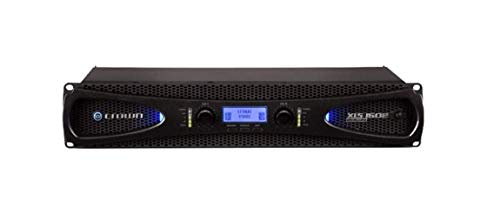
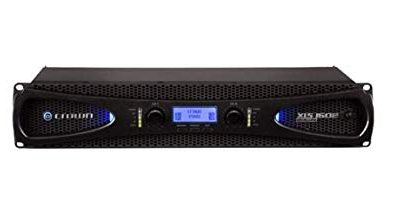
The XLS1502 is a two-channel rack amplifier built around Crown DriveCore Class-D technology, and it brings serious headroom to a vinyl system with large or demanding speakers. The listing gives 525 watts per channel at 4 ohms and 300 watts at 8 ohms, with 1550 watts bridged at 4 ohms for a single channel. Built-in DSP adds band-pass filters and Peak Limiters, which help when the amplifier also drives a subwoofer or a bi-amped setup. At 8.6 pounds and 7.7 by 19 by 3.5 inches, it fits a standard rack without the weight of older linear designs.
Specs
- 2-channel Class D DriveCore amplifier
- XLR and RCA inputs
- 525W per channel at 4 ohms; 300W at 8 ohms
- 1550W bridged at 4 ohms
- DSP with band-pass filters and Peak Limiters
- 8.6 lb; 7.7 x 19 x 3.5 inches
Best for: Large speakers in a big room where headroom matters.
Watch out for: This ASIN was verified through a catalog mirror only — confirm the listing on the product page before ordering.
Rockville D12

The D12 is a rack amplifier aimed at setups that mix vinyl with pro-style speakers and a subwoofer. The listing quotes 5000 watts peak and 1400 watts RMS at 4 ohms, with 700 watts RMS at 8 ohms, and it offers XLR and quarter-inch inputs with Speakon and binding-post outputs. An LCD shows volume and temperature, a crossover switch covers bypass, 80, and 160 Hz, and stereo, parallel, and bridge modes cover most wiring layouts. The 1.5U chassis weighs 9.7 pounds, so it slots into a rack without taking much vertical space.
Specs
- 2-channel Class D amplifier
- 5000W peak / 1400W RMS at 4 ohms; 700W RMS at 8 ohms
- XLR and 1/4-inch inputs; Speakon and binding-post outputs
- LCD volume and temperature display
- Crossover bypass / 80 / 160 Hz; stereo, parallel, and bridge modes
- 1.5U rack chassis; 9.7 lb
Best for: A rack setup with pro-style speakers and a subwoofer.
Watch out for: This ASIN was verified through a catalog mirror only — confirm the listing on the product page before ordering.
Which One Fits Your Situation
A Small Room and a Turntable on a Desk
Pick the Fosi Audio ZA3. Its compact footprint sits beside a turntable without crowding the desk, the balanced XLR inputs keep the low-level phono signal clean, and 190 watts per channel is more than enough for bookshelf speakers at nearfield distance. The subwoofer output is a bonus if your main speakers are small and you want the low end filled in later.
A Dedicated Listening Room Built Around Monoblocks
Buy two Fosi Audio V3 Mono units, one per channel. Separating the channels gives each speaker its own amplifier and power path, which suits a dedicated room where the turntable and phono stage already set a high bar. The switchable gain helps match a low-output phono stage, and the balanced XLR inputs keep long cable runs quiet between the preamplifier and the monoblocks.
Large Speakers in a Big Room
Choose the Crown XLS1502. Its 525 watts per channel at 4 ohms and 300 watts at 8 ohms give large or low-sensitivity speakers the headroom they need to play cleanly at volume, and the bridged mode is there if a single channel ever needs more. The built-in DSP with band-pass filters and Peak Limiters helps when the system also includes a subwoofer.
A Rack Setup with Pro Speakers and a Subwoofer
Go with the Rockville D12. The 1.5U chassis fits a standard rack, the Speakon and binding-post outputs suit pro-style speakers, and the crossover switch with bypass, 80, and 160 Hz settings makes it easy to hand the low end to a subwoofer. Stereo, parallel, and bridge modes cover the wiring layouts most rack systems use.
Common Mistakes
- Buying one monoblock and expecting stereo sound — the V3 Mono drives a single channel, so a stereo setup needs two.
- Reading peak watts as continuous power — compare RMS figures at the same impedance when judging how loud an amplifier really plays.
- Running long unbalanced RCA cables past power supplies and routers, then blaming the amplifier for hum that balanced XLR would have rejected.
- Bridging an amplifier into speakers whose impedance is below the bridged rating on the listing.
- Connecting a turntable straight into a power amplifier — a power amp has no phono input, so a phono stage has to sit in between.
Frequently Asked Questions
Do I need a phono stage with a power amplifier?
Yes. A power amplifier only adds gain to a line-level signal and has no phono input, while a turntable cartridge puts out a signal far below line level and needs equalization. A standalone phono stage, or a receiver with a phono input, has to sit between the turntable and the amplifier, and its output then connects to the amplifier through RCA or balanced XLR.
Are balanced inputs worth it for vinyl listening?
They are worth it when the cable run is long or the room is noisy. Balanced XLR connections cancel interference that both wires pick up, which protects the low-level signal from a phono stage. For a short run on a quiet desk, RCA sounds the same in practice, so choose balanced inputs when the amplifier sits far from the phono stage or cables pass near power supplies.
Can one Fosi Audio V3 Mono drive two speakers?
No. The V3 Mono is a single-channel monoblock, so one unit drives one speaker and a stereo setup needs two. That is the whole point of the design: each channel gets its own amplifier and power path. If you only want one box for a pair of speakers, pick a stereo amplifier such as the Fosi Audio ZA3 instead.
How much power do my speakers actually need?
It depends on speaker sensitivity and room size. Efficient speakers play loudly on modest power, while low-sensitivity speakers in a large room need far more. Check the sensitivity figure and the recommended amplifier range on the speaker listing, then pick an amplifier with comfortable headroom above your normal listening level rather than chasing the largest wattage number.