Key takeaways
- Find the best class-ab power amplifiers with rca inputs for clean, powerful stereo sound, with buying guidance on power, inputs, and setup.
The best class-ab power amplifiers with rca inputs give a stereo system something a receiver or an integrated amplifier often cannot: dedicated, unhurried power for the speakers alone. A power amplifier has one job, and a good Class-AB design does that job with the warmth and control that have made this topology a favorite among music listeners for decades. RCA inputs matter because they are the universal language of home audio. Nearly every preamplifier, DAC, streamer, turntable phono stage, and AV receiver with pre-outs speaks RCA, so an amplifier with RCA inputs slots into almost any existing system without adapters or fuss.
Choosing the right amplifier is less about chasing the biggest wattage number and more about matching power, sensitivity, room size, and connectivity to the way you actually listen. An amplifier that is too weak for demanding speakers will sound strained at higher volumes, while an oversized amplifier in a small room is simply unused headroom. This guide explains what to look for, then profiles three stereo Class-AB power amplifiers with RCA inputs that cover a wide range of systems, from a compact desktop or second-room setup to a full-size living-room rig driving floorstanding speakers.
How to Choose
1. Power Output and Speaker Sensitivity
Power output, measured in watts per channel into 8 ohms, is the headline number on every amplifier, but it only makes sense alongside speaker sensitivity. A speaker rated at 90 dB sensitivity needs far less power to reach a given volume than one rated at 84 dB. As a rough guide, a small room with efficient bookshelf speakers can sound excellent with 50 to 75 watts per channel, while large floorstanding speakers in a spacious room, or speakers with low sensitivity, benefit from 140 watts per channel or more. Check the amplifier’s 4-ohm figure too, since many speakers dip toward 4 ohms at some frequencies, and an amplifier that doubles down into lower impedances will handle those dips with more composure.
2. Class-AB Design and Sound Character
Class-AB amplification blends the linearity of Class-A operation at low levels with the efficiency of Class-B operation at higher levels. The result is a sound that many listeners describe as smooth and natural, with low distortion and a relaxed presentation that suits long listening sessions. When comparing amplifiers, look for a substantial power supply, generous heat sinking, and a low total harmonic distortion figure. A heavy chassis is often a good sign, since it usually indicates a large toroidal transformer and ample capacitance, both of which help the amplifier deliver current on demand during dynamic passages.
3. RCA Inputs and Input Flexibility
Every amplifier in this guide has RCA inputs, but the details still matter. Gold-plated RCA jacks resist corrosion and maintain a solid connection over years of use. Some amplifiers also offer balanced XLR inputs, which are useful if your preamplifier supports them, but RCA remains the standard for most home systems. Consider how many input options you need: a single stereo RCA pair is enough if one preamplifier feeds the amplifier, while switchable inputs or a pass-through can help in more complex setups. Also confirm that the input sensitivity matches your source, since a mismatch can leave you with too little volume range or too much gain.
4. Bridging, Mono Mode, and Future Expansion
Several stereo power amplifiers can be bridged into a single, more powerful mono channel. This is a valuable feature if you think you might one day buy a second identical amplifier and run one per speaker. Bridging typically doubles or triples the available power into a single channel, which can transform a modest stereo amplifier into a serious monoblock. Even if you never bridge, the presence of a bridge mode usually signals a robust output stage. Check whether bridging requires a switch on the rear panel and whether the minimum speaker impedance changes in bridged mode, since some amplifiers require 8-ohm speakers when bridged.
5. Trigger, Auto-On, and Everyday Convenience
A power amplifier is often hidden in a rack or cabinet, so remote turn-on features matter more than they first appear. A 12-volt trigger input lets a preamplifier or AV receiver switch the amplifier on and off automatically, while signal-sensing auto-on powers the amplifier up when music starts playing. Both features remove the need to reach behind the rack every time you listen. A front-panel power switch and clear status indicators are still welcome for manual control, and a detachable power cord makes installation easier in tight spaces.
6. Size, Ventilation, and Placement
Class-AB amplifiers generate heat, and they need room to breathe. Before buying, measure your shelf or rack and confirm the amplifier’s width, depth, and height, including clearance for cables at the rear. Leave several inches of open space above the amplifier and avoid stacking other components directly on top of it. A full-width, full-depth chassis is normal for higher-powered models, while compact amplifiers can fit on a desk or a small shelf. Weight is also worth considering: a heavier amplifier may need a sturdier shelf, and moving it during setup is easier with a second pair of hands.
7. Build Quality, Protection, and Longevity
A power amplifier is a long-term purchase, and build quality is a reasonable proxy for how long it will serve you. Look for a rigid metal chassis, solid speaker binding posts that accept bare wire, spades, or banana plugs, and internal protection circuitry that guards against overheating, short circuits, and DC faults. A well-built amplifier should run warm but not alarmingly hot during normal use, and its binding posts should grip speaker cables firmly without wobbling. A clear, readable manual and a sensible warranty round out the picture.
Top Picks
Emotiva BasX A2 Stereo Power Amplifier

Emotiva BasX A2 Stereo Power Amplifier
The Emotiva BasX A2 is a two-channel Class-AB power amplifier that delivers 160 watts per channel into 8 ohms and 250 watts per channel into 4 ohms, with all channels driven. That is a serious amount of power for a stereo amplifier in its class, and it makes the A2 a strong match for floorstanding speakers and for listeners who enjoy dynamic music at realistic volumes. The amplifier is built around a heavy-duty linear power supply with an oversized toroidal transformer, which helps it deliver current when demanding passages ask for it.
On the rear panel, the A2 offers both unbalanced RCA inputs and balanced XLR inputs, so it connects to virtually any preamplifier, DAC, or AV receiver with pre-outs. A trigger input and output allow the amplifier to switch on and off with the rest of the system, and a signal-sensing auto-on mode powers the amplifier up when an audio signal arrives at its input. That combination is handy when the preamplifier in the system has no trigger output of its own. Transparent fault protection monitors the amplifier and guards against common problems without intruding on normal listening.
The A2 is a full-size component at 17 inches wide, so it belongs on a proper shelf or rack rather than a crowded desktop. Its rated total harmonic distortion is below 0.02 percent, and its signal-to-noise ratio is rated at 112 dB A-weighted, figures that speak to a quiet background and clean reproduction. The chassis is finished in black and keeps its front panel simple, with a power button and status indicators.
Who it is for: listeners building or upgrading a serious two-channel system, anyone driving floorstanding or low-sensitivity speakers, and home theater owners who want to give their front left and right speakers dedicated power from an AV receiver’s pre-outs.
Caveats: the A2 is a full-size, heavy component that needs ventilation space above it and a sturdy shelf. It has no volume control, tone controls, or source switching, so it must be paired with a preamplifier or a receiver with pre-outs. It also has no wireless connectivity, which is normal for a dedicated power amplifier but worth knowing before purchase.
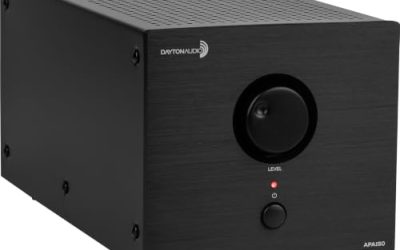
Dayton Audio APA150 150W Power Amplifier

Dayton Audio APA150 150W Power Amplifier
The Dayton Audio APA150 is a compact and versatile Class-AB power amplifier that delivers 75 watts per channel in stereo mode, or 150 watts into 8 ohms when switched to bridge-mono mode. That flexibility makes it useful in more than one role: as a stereo amplifier for a pair of bookshelf speakers, as a single-channel amplifier for a center speaker or a passive subwoofer in a small system, or as a zone amplifier in a multi-room setup. Its modest size sets it apart from the full-width amplifiers in this guide.
The APA150 has stereo RCA inputs on the rear panel, along with a level control, a bridge-mono switch, and speaker terminals that accept common connection types. The front panel carries a power switch and a volume knob, which is unusual for a power amplifier and makes the APA150 easy to use in a simple system where a separate preamplifier is not present. A detachable power cord and a compact footprint mean it can sit on a desk, a bookshelf, or a small equipment stand without dominating the space.
Because the APA150 is a Class-AB design, it shares the smooth, low-distortion character of the larger amplifiers here, while its smaller power supply and chassis keep it approachable for first-time buyers. The bridge-mono mode is a genuine asset: a listener who starts with one APA150 in stereo can add a second later and run one per channel, or bridge a single unit for a more demanding single speaker.
Who it is for: listeners setting up a first stereo system, anyone powering bookshelf speakers in a bedroom, office, or workshop, and multi-room users who need a compact amplifier for a secondary zone.
Caveats: with 75 watts per channel, the APA150 is not the right choice for large rooms or very demanding floorstanding speakers at high volumes. Its compact chassis means less heat sinking than a full-size amplifier, so it needs clear airflow around it. The front-panel volume control is convenient, but in a system with a proper preamplifier it should be set once and left alone to avoid accidental changes.
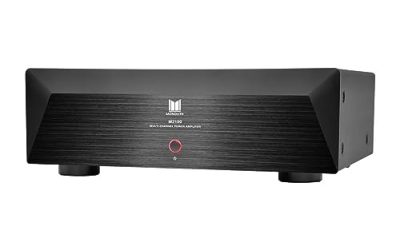
Marantz MM7025 Stereo Power Amplifier

Marantz MM7025 Stereo Power Amplifier
The Marantz MM7025 is a two-channel Class-AB power amplifier rated at 140 watts per channel into 8 ohms. It is a classic example of the breed: a full-size, well-built component with a linear power supply, a large toroidal transformer, and the kind of understated styling that fits into a traditional hi-fi rack. The MM7025 is designed to work with a Marantz AV receiver or preamplifier, but its standard RCA inputs mean it pairs just as well with equipment from other brands.
The rear panel offers both single-ended RCA inputs and balanced XLR inputs for each channel, along with a 12-volt trigger input, remote control input and output jacks, and sturdy speaker binding posts. A switch on the rear selects between RCA and XLR input, and the amplifier can be set to normal stereo operation or bridged for higher single-channel output. The front panel has a circular display, an on and standby button, and a display on and off button, keeping the fascia clean and uncluttered.
Inside, the MM7025 uses a current-feedback amplifier design and a low-impedance power supply, both aimed at maintaining control over the speakers during dynamic swings. The amplifier runs quietly, with a silent cooling system that avoids fan noise in a listening room, which matters for music listeners who value a low noise floor. Its build quality is evident in the weight of the chassis and the solidity of its connectors.
Who it is for: listeners who want a refined, full-size stereo power amplifier for a living-room system, home theater owners adding dedicated two-channel power for their front speakers, and anyone who values quiet operation and a traditional hi-fi presentation.
Caveats: the MM7025 is a full-width component that needs rack space and ventilation. It is a power amplifier only, so a preamplifier or receiver with pre-outs is required. As a model that has been on the market for a long time, buyers should confirm that the unit they are considering is the current configuration and that all included accessories are present.
Comparison Table
| Feature | Emotiva BasX A2 | Dayton Audio APA150 | Marantz MM7025 |
|---|---|---|---|
| Amplifier class | Class AB | Class AB | Class AB |
| Channels | 2 (stereo) | 2 (stereo) | 2 (stereo) |
| Power per channel, 8 ohms | 160 watts | 75 watts | 140 watts |
| Power per channel, 4 ohms | 250 watts | Not specified for stereo | Higher than 8-ohm figure |
| RCA inputs | Yes | Yes | Yes |
| Balanced XLR inputs | Yes | No | Yes |
| Bridge-mono mode | No | Yes | Yes |
| 12V trigger | Yes, in and out | No | Yes, in |
| Signal-sensing auto-on | Yes | No | No |
| Front-panel volume control | No | Yes | No |
| Size class | Full width | Compact | Full width |
| Best suited room | Medium to large | Small to medium | Medium to large |
Which One Is Right for You?
Start with your speakers and your room, since those two factors decide how much power you actually need. If you listen in a small room with efficient bookshelf speakers, the Dayton Audio APA150 covers the essentials: RCA inputs, enough power for comfortable listening, and a compact chassis that fits where a full-size amplifier will not. Its bridge-mono mode also gives you a path to more power later without replacing the unit.
If you have floorstanding speakers, a large room, or speakers with low sensitivity, step up to one of the full-size amplifiers. The Emotiva BasX A2 offers the highest power output of the three, along with trigger control and signal-sensing auto-on, which makes it a natural fit for a system that is switched on and off as a whole. The Marantz MM7025 sits close behind on power and adds a refined presentation, balanced XLR inputs, and a bridge mode, which suits listeners who want a traditional hi-fi component that can grow with their system.
Connectivity is the second decision point. All three amplifiers have RCA inputs, so any of them will connect to a standard preamplifier. If your preamplifier has balanced outputs and your cable runs are long, the XLR inputs on the Emotiva and Marantz models are a genuine advantage. If your system is simple and your cables are short, RCA alone is entirely sufficient, and the Dayton Audio model proves the point.
Finally, think about how the amplifier will be used day to day. A trigger input or auto-on feature matters if the amplifier will live in a closed cabinet. A front-panel volume control matters if the amplifier will be used without a preamplifier. And physical size matters everywhere, since an amplifier that does not fit its shelf is an amplifier that cannot be used at all. Match the amplifier to the system you have, not the system you imagine, and the result will be a component that serves you for years.
Frequently Asked Questions
Do I need a preamplifier to use a power amplifier with RCA inputs?
Yes, in almost every case. A power amplifier has no volume control or source selection, so it needs a preamplifier, a DAC with volume control, or an AV receiver with pre-outs to feed it a line-level signal through its RCA inputs. The Dayton Audio APA150 is an exception in this guide, since it has a front-panel volume control that allows basic use without a separate preamplifier, though a proper preamplifier still gives better control.
What is the difference between Class-AB and other amplifier classes?
Class-AB amplifiers combine two operating modes: they run in a low-distortion mode at small signal levels and switch to a more efficient mode as output rises. This gives them a smooth, natural sound with low distortion and reasonable efficiency. Other designs, such as Class-D amplifiers, use switching technology and are smaller and cooler running, but many listeners prefer the presentation of a well-designed Class-AB amplifier for music.
Can I connect a power amplifier directly to a turntable?
No, not directly. A turntable produces a very low-level signal that needs a phono preamplifier to bring it up to line level and apply the correct equalization. Connect the turntable to a phono stage first, then connect the phono stage, or a preamplifier with a built-in phono stage, to the power amplifier’s RCA inputs.
How much ventilation does a Class-AB power amplifier need?
Class-AB amplifiers convert part of their power into heat, so they need open space around them. Leave several inches of clearance above the chassis, keep the ventilation slots unobstructed, and avoid placing other components directly on top of the amplifier. If the amplifier will live inside a closed cabinet, make sure the cabinet has ventilation openings or a quiet fan, and check that the amplifier feels warm rather than hot during use.
Disclosure: As an Amazon Associate, we may earn from qualifying purchases.