Key takeaways
- Five Class-AB power amplifiers for whole-home audio, compared by channels, output, inputs and trigger control to match one to your rooms and speakers.
A whole-home audio upgrade usually comes down to one practical decision: whether the amplifier behind the walls can drive every pair of speakers in the house without sounding thin in the largest room or running hot in a closed rack. A receiver with a built-in tuner and video switching often spreads its attention too widely, while a dedicated Class-AB power amplifier concentrates on one job, turning a line-level signal into clean, steady power for the speakers connected to it.
This guide is for homeowners adding music to several rooms, for listeners upgrading a main stereo pair, and for anyone replacing a weak zone amplifier with something built for continuous use. Each amplifier below was chosen from its Amazon listing by channel count, output, inputs, and control features, so you can compare the five on the same terms and pick the layout that fits your rooms.
Quick Picks
As an Amazon Associate we earn from qualifying purchases.
| Product | Best for | Key spec |
|---|---|---|
| Dayton Audio APA150 | One stereo zone or a single subwoofer channel | 75 watts per channel into 4 ohms, 150 watts bridged into 8 ohms |
| AudioSource AMP100 | Two rooms from one compact stereo amplifier | 50 watts per channel into 8 ohms, A/B speaker switching |
| Dayton Audio MA1240a | Six stereo zones from a single rack unit | 12 channels, 40 watts per channel into 8 ohms |
| Marantz MM7025 | A demanding main stereo pair | 140 watts per channel into 8 ohms, balanced XLR inputs |
| OSD Audio Nero HTA5200 | Five channels for a large room or home theater | 210 watts per channel into 4 ohms, 145 watts into 8 ohms |
How to Choose
Count zones before you count watts
Start with a sketch of the house, not a specification sheet. Mark every room that needs sound, then group rooms that always play together into one zone. A kitchen and an adjoining dining area can share a stereo pair, while a bedroom and a patio need separate control. A two-channel amplifier covers one zone, a five-channel model covers two zones plus a spare channel, and a twelve-channel model covers six stereo zones. Buying too few channels forces an awkward compromise later, such as wiring two rooms to one volume control, while buying far more channels than the house needs leaves unused outputs sitting in a rack. Match the channel count to the sketch first, then look at output.
Match output to the room and the speakers
Output matters most in large rooms, rooms with high ceilings, and rooms where speakers sit far from the listening position. A small bedroom with efficient bookshelf speakers needs far less power than a vaulted living room with floor-standing speakers. Check the speaker impedance as well, because an amplifier that delivers a stated output into 8 ohms will behave differently with a 4-ohm load, and some models state separate figures for each. Bridged mode can help when one zone needs extra drive, such as a single subwoofer or a large center speaker, but bridging usually halves the number of available channels. Choose enough headroom for loud passages without pushing the amplifier near its limit all day.
Check inputs, triggers, and automatic turn-on
A whole-home amplifier often sits in a closet or a rack, out of reach, so its control features matter as much as its sound. Look for a 12-volt trigger input if your preamplifier or control system can switch the amplifier on and off with the rest of the system. Signal-sensing automatic turn-on serves the same purpose when no trigger is available, waking the amplifier when music starts and letting it rest when the signal stops. Count the line-level inputs too: a dual-source model can switch between two sources, while a multi-zone model may give each zone its own input plus shared bus inputs. Confirm that the input connectors match your source, whether that means RCA, balanced XLR, or both.
Plan for heat, space, and ventilation
Class-AB amplifiers generate more heat than compact digital designs, and that heat needs somewhere to go. Measure the rack or shelf before ordering, including depth for cables and binding posts, and leave clear space above the unit for warm air to escape. Heavy models with large transformers need a sturdy shelf and help from a second person during installation. If the amplifier will live in a closed cabinet, plan ventilation slots or a quiet fan, and keep the top clear of books, boxes, and other equipment. A model with a built-in fan needs its airflow path kept clear, while a passively cooled model needs even more open space around its heat sinks.
The 5 Best Options
Dayton Audio APA150

The Dayton Audio APA150 suits a single stereo zone, a second room fed from a main system, or a dedicated subwoofer channel when switched to bridged mono. Its switchable low-pass filter makes the subwoofer role straightforward, since the filter can shape the signal before it reaches the driver, and its compact width fits shelves where a full-size component would not. Gold-plated binding posts accept heavier speaker wire, which helps when the run from the rack to the speakers is long. This is a practical starting point for a first whole-home zone, and it can later move to a smaller room if a larger amplifier takes over the main space.
Specs
- Class A/B topology
- 75 watts RMS per channel into 4 ohms
- 150 watts RMS bridged into 8 ohms
- Adjustable low-pass crossover, 50 Hz to 150 Hz
- RCA line-level inputs and outputs
- Gold-plated five-way binding posts
- Signal-to-noise ratio above 100 dB, unweighted
- Weight: 13 lbs
Best for: A single stereo zone, a second room, or a bridged subwoofer channel.
Watch out for: Bridged mode uses both channels for one output, so plan the zone layout before switching modes.
AudioSource AMP100

The AudioSource AMP100 suits homes where one amplifier must serve two pairs of speakers without a separate switch box. Its front-panel A/B selector lets you play the A pair, the B pair, or both together, which covers a living room and a patio, or a bedroom and a study, from a single chassis. Front-panel volume and balance controls make small adjustments easy without reaching behind the unit, and the rear bass and treble controls help tune a room that sounds too bright or too dull. Five-way binding posts accept bare wire or banana plugs, so the speaker connections stay simple even when the cable runs differ between rooms.
Specs
- Class AB amplifier design
- 50 watts per channel into 8 ohms
- 60 watts per channel into 4 ohms
- A, B, or A/B speaker selector
- Front-panel volume and balance controls
- Rear-panel bass and treble controls
- Five-way binding posts
- RCA line inputs
Best for: Two speaker pairs from one amplifier, such as a living room and a patio.
Watch out for: Running both pairs at once divides the available drive, so check speaker impedance before using A+B mode.
Dayton Audio MA1240a

The Dayton Audio MA1240a is the multi-zone workhorse of this group, with twelve channels arranged as six stereo zones in a single rack-mount chassis. Each zone has its own input and level adjustment, while two shared bus inputs can feed the same source to every zone at once, which suits a house where most rooms play the same music and one or two rooms need something different. Channels can be bridged in pairs for zones that need more drive, and automatic, manual, and 12-volt trigger turn-on modes help the unit fit into a controlled rack. Removable rack ears and a two-rack-unit height keep the installation tidy.
Specs
- Class AB output circuit
- 12 channels, six stereo zones
- 40 watts per channel into 8 ohms
- 60 watts per channel into 4 ohms
- 80 watts bridged into 8 ohms
- 12 individual inputs and two stereo bus inputs
- Independent level adjustment for each channel
- Automatic, manual, and 12-volt trigger turn-on modes
Best for: Whole-home systems with up to six stereo zones in one rack unit.
Watch out for: Twelve channels need twelve speaker runs and careful labelling, so map every zone before pulling cable.
Marantz MM7025

The Marantz MM7025 suits a main listening room where the speakers are demanding and the source equipment is already strong. Its current-feedback Class A/B design delivers 140 watts per channel into 8 ohms, with a separate figure of 170 watts per channel into 6 ohms, giving the headroom that large floor-standing speakers need for dynamic passages. Both balanced XLR and unbalanced RCA inputs are provided, so it connects cleanly to a high-end preamplifier or to a receiver with preamplifier outputs. A porthole display with blue illumination marks the front panel, and the chassis accepts an optional rack-mount kit for a built-in installation.
Specs
- Current-feedback Class A/B amplification
- 140 watts per channel into 8 ohms
- 170 watts per channel into 6 ohms
- Balanced XLR and unbalanced RCA inputs
- Signal-to-noise ratio: 105 dB
- Frequency response: 8 Hz to 100 kHz
- Porthole display with blue illumination
- Optional rack-mount kit available
Best for: A demanding main stereo pair in a large listening room.
Watch out for: The chassis is deep and heavy for a two-channel unit, so measure shelf depth and check the rack load before ordering.
OSD Audio Nero HTA5200

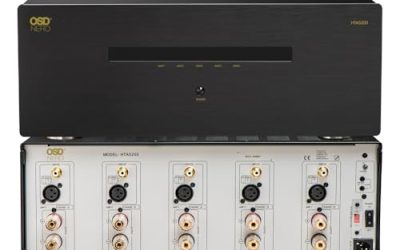
The OSD Audio Nero HTA5200 suits a large room that needs five strong channels, whether that means a home theater front stage plus surrounds or several zones grouped around one powerful unit. It delivers 210 watts per channel into 4 ohms and 145 watts per channel into 8 ohms with all channels driven, so the output stays consistent when every channel works at once. Balanced XLR and unbalanced RCA inputs cover both professional-style preamplifiers and standard home equipment, while a 12-volt trigger and channel status LEDs help with rack control and quick checks. Its signal-to-noise figure of 110 dB keeps quiet passages clean.
Specs
- 5-channel Class AB amplifier
- 210 watts per channel into 4 ohms, all channels driven
- 145 watts per channel into 8 ohms, all channels driven
- Balanced XLR and unbalanced RCA inputs
- 12-volt trigger input and output
- Channel status LEDs
- Signal-to-noise ratio: 110 dB
Best for: Five channels in a large room, a home theater, or several grouped zones.
Watch out for: Five channels at full drive generate substantial heat, so give the rack generous ventilation and clear space above the unit.
Which One Fits Your Situation
You are adding music to one room
Choose the Dayton Audio APA150 for a single stereo zone, and the AudioSource AMP100 if that zone might grow to a second pair of speakers. The APA150 gives a clean stereo feed plus a bridged option for a subwoofer, while the AMP100 adds A/B switching for two rooms. Either one fits a shelf or a small rack, and either one can move to a smaller room later if a larger amplifier takes over the main space.
You are wiring the whole house at once
Choose the Dayton Audio MA1240a, because it covers six stereo zones from one chassis with individual inputs and shared bus inputs. That layout avoids stacking several stereo amplifiers, keeps the rack tidy, and lets each room keep its own level setting. Map every speaker run before ordering, label both ends of each cable, and confirm that the rack has room for the unit plus ventilation space above it.
You are upgrading the main stereo pair
Choose the Marantz MM7025 if the main speakers are large or hard to drive and the source equipment already includes a preamplifier or a receiver with preamplifier outputs. Its 140-watt output into 8 ohms and balanced XLR inputs suit a serious listening room, and the extra headroom helps dynamic music stay composed at higher volumes. Check that the shelf can carry its depth and weight before it arrives.
You need five strong channels in one room
Choose the OSD Audio Nero HTA5200 for a large room, a home theater, or a group of zones that share one powerful amplifier. Its five channels deliver the same output with all channels driven, and the XLR inputs suit a preamplifier with balanced outputs. Plan ventilation carefully, keep the top of the unit clear, and confirm that the speaker impedance matches the output figures you are relying on.
Common Mistakes
- Counting rooms instead of zones, then discovering that two rooms sharing one volume control cannot be adjusted separately.
- Choosing an amplifier by its headline output alone without checking the impedance that figure was measured at.
- Forgetting trigger or automatic turn-on, then leaving an amplifier in a closed rack running all day.
- Placing a Class-AB amplifier in a sealed cabinet with no airflow, then wondering why it runs hot and shuts down.
- Ordering before measuring shelf depth, cable clearance, and the weight the shelf can carry.
Frequently Asked Questions
What is a Class-AB power amplifier?
A Class-AB power amplifier is a dedicated amplifier that uses Class-AB output circuitry to turn a line-level signal into speaker-level power. It sits between a preamplifier, streamer, or receiver with preamplifier outputs and the speakers themselves. Unlike a receiver, it contains no tuner or video switching, so its design concentrates on amplification, heat management, and clean power delivery for the connected speakers.
How many channels do I need for whole-home audio?
Count zones, not rooms. A zone is a group of speakers that always play together at one volume. One stereo zone needs two channels, so a house with three zones needs six channels and a house with six zones needs twelve. A twelve-channel model such as the Dayton Audio MA1240a covers six stereo zones, while a two-channel model covers one zone or two speaker pairs through A/B switching.
Can I bridge a stereo amplifier for more power?
Many stereo power amplifiers allow bridging, which combines both channels into a single, stronger output for one speaker or one subwoofer. The Dayton Audio APA150, for example, delivers 150 watts bridged into 8 ohms. Bridging halves the number of available channels, so confirm the bridged impedance and output in the listing before switching modes, and wire the speaker to the terminals marked for bridged use.
Do I need a preamplifier with a power amplifier?
Yes, in most whole-home setups. A power amplifier has no volume control of its own in many cases, or only a level trim, so it needs a line-level source such as a preamplifier, a streamer with variable output, or a receiver with preamplifier outputs. The source sets the volume and chooses the music, while the power amplifier provides the current that drives the speakers in each zone.