Key takeaways
- Three Class-AB power amplifiers with balanced XLR inputs for stereo and home theater, compared by channels, power, and the systems each one suits best.
A power amplifier sits between your processor and your speakers, and the choice that matters most is the match between the amplifier and the rest of your system. Balanced XLR inputs earn their place when cable runs are long, because the balanced connection rejects hum and interference that a single-ended RCA run can pick up along the way. Class AB designs appeal to listeners who want a traditional linear amplifier with a toroidal transformer and real headroom, and who accept a heavier chassis and more warmth in exchange.
This guide covers three amplifiers that pair Class AB output stages with balanced XLR inputs on every channel: a compact two-channel Monolith for stereo rooms, a stronger two-channel Monolith for demanding speakers, and a five-channel Outlaw for home theater. Each one suits a different system, so the right pick depends on how many speakers you drive, how far your cables run, and how much power your room demands.
Quick Picks
As an Amazon Associate we earn from qualifying purchases
| Product | Best for | Key spec from title |
|---|---|---|
| Monolith M2100X | Stereo rooms and first separates systems | 2×90 watts per channel with RCA and XLR inputs |
| Monolith 2X | Demanding speakers in larger rooms | 2×200 watts per channel with XLR inputs |
| Outlaw Audio Model 5000x | Five-channel home theater behind a receiver | 5×120 watts continuous with XLR and RCA inputs |
How to Choose
Match the channel count to your system
Count the speakers the amplifier must drive first. A two-channel amplifier covers a stereo pair, so it fits a music system or a front left and right upgrade inside a larger theater. A five-channel amplifier drives the front three speakers plus two surrounds in one chassis, which keeps wiring simple and leaves the receiver to handle processing only. Buying more channels than your system uses wastes money and rack space, while buying fewer forces an awkward second amplifier into the rack later. List every speaker the new amplifier will power, including any height or surround speakers you plan to add in the next year, and choose the count that covers that list with one spare channel at most.
Match power to your speakers and your room
Watts only make sense beside speaker sensitivity and room size. Efficient speakers in a small room reach satisfying volume with modest power, while low-sensitivity speakers or a large open room ask for far more headroom. Check the continuous power rating into 8 ohms with all channels driven, and treat a rating measured with only one channel driven as a weaker promise. Look at the 4 ohm rating too, since it shows whether the power supply holds up when speaker impedance dips. A generous margin above your normal listening level keeps loud peaks clean, while an amplifier that runs near its limit on every crescendo will sound strained well before its rated output.
Confirm the balanced input is real XLR on every channel
Not every amplifier with an XLR socket gives you a balanced input on each channel, so read the input list channel by channel. The amplifiers in this guide carry one balanced XLR input per channel beside an unbalanced RCA input. Balanced wiring matters most when the processor sits in a separate rack or across the room, since long RCA runs invite hum from nearby power cables and dimmers. Check that your processor or preamplifier has balanced outputs, because an XLR input fed by an adapter from an RCA output gains none of the noise rejection of a true balanced run. Check input sensitivity too, since a weak processor output can leave a high-sensitivity input underdriven.
Plan for size, weight, heat, and ventilation
Class AB amplifiers with toroidal transformers are heavy, deep, and warm, and those physical facts decide whether a model fits your rack as surely as any specification. Measure the depth of your shelf with cables attached, since rear connectors and thick speaker cables add several inches behind the chassis. Leave open space above the amplifier and avoid stacking another component directly on its vents, because trapped heat shortens the life of capacitors and output devices. Check the weight rating of the shelf itself, since a five-channel chassis can approach fifty pounds. Finally, confirm the trigger input, since a 12 volt trigger lets the processor switch the amplifier on and off with the rest of the system.
The 3 Best Options
Monolith M2100X 2-Channel Power Amplifier

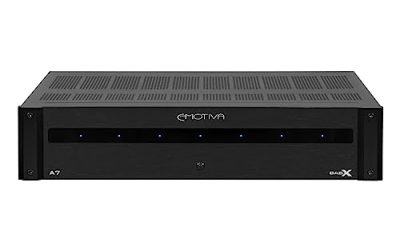
The Monolith M2100X is the sensible entry point into separates for a stereo listener who wants balanced connections. Its 90 watts per channel into 8 ohms covers efficient bookshelf and floor-standing speakers in small and medium rooms, while the 135 watt rating into 4 ohms shows the power supply coping when impedance dips. RCA and XLR inputs sit on each channel, so the amplifier drops into a system built around a stereo preamplifier, a DAC with variable output, or any receiver with preamplifier outputs. A brushed steel front and a single illuminated power button keep the appearance plain.
Specs
- 2 channels of Class AB amplification
- 90 watts per channel into 8 ohms, 135 watts per channel into 4 ohms
- Balanced XLR inputs and unbalanced RCA inputs, one of each per channel
- Total harmonic distortion less than 0.02 percent
- Signal-to-noise ratio greater than 100 dB
- 3RU chassis height
- 3-year replacement warranty
Best for: Stereo listeners moving from a receiver to separates in a small or medium room.
Watch out for: 90 watts per channel may fall short for low-sensitivity speakers in a large room.
ASIN: B0CDBX16R5
Monolith 2X Two-Channel Power Amplifier

The Monolith 2X is the stronger two-channel pick for speakers that ask more of an amplifier. Its 200 watts per channel into 8 ohms and 300 watts per channel into 4 ohms come from a Class AB design built around a toroidal transformer, with no current limiting between the amplifier and demanding loads. Balanced XLR inputs sit beside RCA inputs, so a processor with balanced outputs can drive the amplifier over a long cable run without picking up hum. The chassis is deep and heavy, which follows from a large linear power supply, and it belongs on a sturdy shelf with clear air above it.
Specs
- 2 channels of Class AB amplification
- 200 watts per channel into 8 ohms, 300 watts per channel into 4 ohms
- Balanced XLR inputs and RCA inputs
- Toroidal transformer with no current limiting
- Signal-to-noise ratio of 120 dB
- 17 inches wide, 13.3 inches deep, 7 inches high
Best for: Demanding floor-standing speakers and larger rooms that need real headroom.
Watch out for: The deep, heavy chassis needs a sturdy shelf and clear ventilation above it.
ASIN: B073GHXYX1
Outlaw Audio Model 5000x Five-Channel Power Amplifier

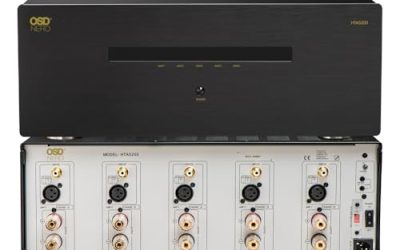
The Outlaw Audio Model 5000x is the pick for a home theater owner whose receiver already handles processing. Five channels at 120 watts each into 8 ohms, or 180 watts each into 4 ohms, cover the front three speakers plus two surrounds. Each channel carries a balanced XLR input with common mode rejection beside a differential-sensing RCA input, so the amplifier accepts either connection from the processor. A modular channel design keeps each signal isolated, and separate protection relays guard each channel. At close to fifty pounds it needs two people to lift safely and a shelf rated for its weight.
Specs
- 5 channels of Class AB amplification
- 120 watts per channel into 8 ohms, 180 watts per channel into 4 ohms, all channels driven
- Balanced XLR inputs with common mode rejection and RCA inputs on every channel
- Total harmonic distortion less than 0.02 percent at rated output into 8 ohms
- Signal-to-noise ratio of 111 dB, A-weighted
- Input sensitivity of 1.2 volts
- 12 volt trigger input
- 5-year parts and labor warranty
Best for: Five-channel home theater systems where a receiver acts as the processor.
Watch out for: Close to fifty pounds, so plan for two people to lift it and a shelf rated for the weight.
ASIN: B08G9RGJCL
Which One Fits Your Situation
Stereo music in a small or medium room
Choose the Monolith M2100X when two speakers in a modest room are the whole system. Its 90 watts per channel drive efficient bookshelf and floor-standing speakers, and the balanced XLR inputs let a preamplifier or DAC sit across the room without hum in quiet passages. The compact 3RU chassis fits a standard rack shelf without dominating it, and the plain front panel suits a living room where the amplifier should blend in rather than draw attention.
Demanding speakers or a large open room
Choose the Monolith 2X when your speakers are hard to drive or your room is large. Its 200 watts per channel into 8 ohms give low-sensitivity speakers the current they need, and the 300 watt rating into 4 ohms shows the power supply holding firm when impedance dips. The toroidal transformer and absence of current limiting keep dynamics intact on loud passages, which is exactly where a smaller amplifier would flatten out and sound strained.
Five-channel home theater behind a receiver
Choose the Outlaw Audio Model 5000x when a receiver already handles decoding and processing and only lacks power. Five channels at 120 watts each cover the front three speakers plus two surrounds, and the balanced XLR inputs accept a clean run from a processor with balanced outputs. The modular channel design and separate protection relays suit a theater that runs for long film sessions, and the trigger input switches the amplifier with the rest of the system.
Long cable runs from processor to amplifier
Choose any of these three when the processor sits far from the amplifier, since each one carries a balanced XLR input on every channel. Balanced wiring rejects the hum and interference that long single-ended runs collect from power cables and dimmers, which matters most when cables cross a room or run through a wall. Match the amplifier to your channel count first, then use XLR cables throughout, and keep the balanced run away from mains wiring.
Common Mistakes
- Buying on watts alone without checking speaker sensitivity, impedance, and room size, which together decide how much power you actually need.
- Assuming any XLR socket means a balanced signal path, when some equipment wires the socket to an unbalanced circuit inside.
- Stacking another component on top of a Class AB amplifier and blocking its vents, which traps heat and shortens component life.
- Forgetting that a power amplifier has no volume control or input switching, so a preamplifier, processor, or receiver with preamplifier outputs is still required.
- Running long single-ended RCA cables beside mains wiring and then blaming the amplifier for hum that the cable run introduced.
Frequently Asked Questions
Do I need balanced XLR inputs, or is RCA enough?
RCA is enough for short runs between components on the same shelf, since a short cable rarely picks up audible interference. Balanced XLR earns its place when the processor and amplifier sit apart, when cables run near mains wiring, or when a system already suffers from hum. If your processor has balanced outputs and the run is long, choose an amplifier with a genuine balanced XLR input on each channel.
What does Class AB mean for sound and heat?
Class AB is a traditional linear design in which the output devices share the workload, giving linear warmth and headroom with better efficiency than pure Class A. The trade is heat and size, since the output stage dissipates energy even at idle and needs a large toroidal transformer. Give it open air above its vents and a sturdy shelf, and it will run warm by design rather than by fault.
Can I use a power amplifier with my AV receiver?
Yes, provided the receiver has preamplifier outputs for the channels the amplifier will drive. Connect the receiver preamplifier outputs to the amplifier inputs, RCA or XLR as the receiver supports, and connect the speakers to the amplifier binding posts instead of the receiver. The receiver then handles decoding, processing, and volume, while the amplifier supplies the current. Check the receiver manual for its preamplifier output layout before ordering cables.
How much power do my speakers need?
Begin with speaker sensitivity and room size, not a wattage number alone. Efficient speakers in a small room reach satisfying volume with modest power, while low-sensitivity speakers in a large room need far more headroom. Check the continuous rating into 8 ohms with all channels driven, and the 4 ohm rating to see whether the power supply holds up when impedance dips. A margin above listening level keeps dynamics clean.