Key takeaways
- Compare balanced Class-D power amplifiers with XLR inputs from Crown and Behringer by output power, DSP, bridging and weight to drive speakers well.
A power amplifier sits at the end of the signal chain, and it is the one box that should add nothing but gain. When the feed comes from a mixing desk, an audio interface or a system processor, a balanced XLR connection keeps that feed quiet over long cable runs, and a Class-D output stage delivers serious wattage without the weight and heat of older designs. The catch is that spec sheets mix continuous and peak ratings, balanced and unbalanced inputs, and DSP suites of very different depth, so the headline wattage rarely tells the whole story.
This guide lines up four balanced Class-D power amplifiers that are current, rack-mountable and fed the way professional gear expects to be fed: through balanced XLR inputs. Three come from Crown’s XLS DriveCore 2 range, which has become the default recommendation for portable rigs and small installations, and one comes from Behringer’s NX series, which trades a little refinement for a deep DSP package. Work through the power figures, the input sensitivity and the processing, and the right amplifier for your speakers picks itself.
As an Amazon Associate, we earn from qualifying purchases.
Quick Picks
| Product | Best for | Key point |
|---|---|---|
| Crown XLS 1502 | Most rigs that need one dependable stereo amp for mains or monitors | The middle of the XLS range: real headroom, full DSP and a selectable input sensitivity |
| Crown XLS 1002 | Smaller rooms, monitor wedges and compact portable systems | The same DriveCore platform and balanced inputs in the lightest, lowest-power chassis |
| Crown XLS 2002 | Bigger speakers, hungrier tops and subwoofer duty in bridge mode | The strongest XLS here, with the same crossover and limiter tools as its siblings |
| Behringer NX3000D | Buyers who want deep DSP tuning and high peak output on a tight budget | Built-in delay, parametric EQ and dynamic EQ with USB control, plus balanced combo inputs |
How to Choose
Insist on genuinely balanced inputs. A balanced XLR input rejects hum and interference picked up along the cable, which matters every time the amplifier rack sits more than a few metres from the desk. All four amplifiers here take balanced XLR. Note that several of them also carry RCA sockets for convenience; those RCA inputs are unbalanced, so treat them as a fallback for short consumer-level runs, not as part of a balanced chain.
Read the power rating before the wattage. Manufacturers quote output in different ways. Crown rates the XLS range as continuous power, while Behringer quotes peak figures for the NX3000D, so a bigger number on the Behringer does not automatically mean a louder amplifier in sustained use. Compare like with like: watts per channel into the impedance your speakers actually present, usually 8 or 4 ohms, and check the bridged figure if you plan to run one cabinet or a subwoofer from both channels combined.
Match input sensitivity to your source. Professional desks and processors output a healthy balanced level, and every amplifier here is built for that world. The Crown XLS models add a selectable input sensitivity, with a higher-gain setting that helps when the source is a quieter interface or a consumer preamp. If an amplifier seems oddly quiet at sensible desk levels, the sensitivity setting, not a fault, is the first thing to check.
Decide how much DSP you will really use. A band pass filter per channel and a good limiter, as fitted across the Crown range, cover the common jobs: keeping subsonic energy out of full-range cabinets and protecting drivers at high level. The Behringer NX3000D goes much further, with delay, parametric EQ and dynamic EQ for aligning and tuning a system. Deep DSP is valuable in a fixed installation; in a grab-and-go rig it can be one more menu to manage under time pressure.
Think about the room the amplifier lives in. Class-D designs run cool and light, which is why every unit here weighs under 11 pounds and fits a 2U rack space. All of them use fans, however, and fan noise that is irrelevant at a live event can intrude in a quiet studio or a small listening room. If the rack shares a room with microphones, plan its position with the same care you give to computer noise.
Best Options
Crown XLS 1502
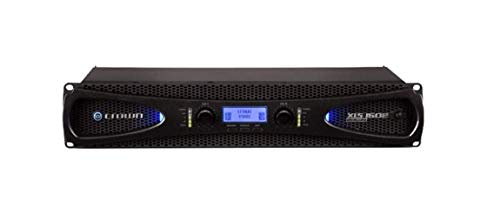
The XLS 1502 is the centre of Crown’s DriveCore 2 range and the easiest amplifier here to recommend without conditions. It delivers 525 watts per channel into 4 ohms as a continuous rating, bridges to 1550 watts into 4 ohms for a single subwoofer or centre cabinet, and does it from a chassis that weighs 8.6 pounds. For a pair of typical 12-inch or 15-inch passive tops, that is comfortable headroom rather than a figure you have to nurse.
The processing covers the jobs most systems need. A band pass filter on each channel, the PureBand crossover system and Peakx limiters let you protect speakers and tidy the low end without an external processor, and the front-panel LCD makes setup a menu exercise rather than a row of hidden switches. Balanced XLR inputs anchor the signal path, with quarter-inch TRS and RCA sockets alongside for other sources.
Specs
- 2-channel Class D power amplifier with DriveCore 2 technology; balanced XLR inputs (2), plus 1/4-inch TRS and RCA inputs; output 525 W per channel at 4 ohms, 300 W per channel at 8 ohms, 775 W per channel at 2 ohms; bridged output 1550 W at 4 ohms and 1050 W at 8 ohms; selectable input sensitivity of 1.4 Vrms or 0.775 Vrms; DSP with band pass filter per channel, PureBand crossover system and Peakx limiters; rack mount, 19 x 3.5 x 7.7 inches; weight 8.6 lb
Best for: Most rigs that need one dependable stereo amp for mains or monitors
Watch out for: The RCA inputs are unbalanced, so keep the balanced chain on XLR; the forced-air fan is quiet but not silent in a small room
Crown XLS 1002

The XLS 1002 is the entry point to the same platform: the same DriveCore Class-D stage, the same balanced XLR inputs and the same DSP toolkit, scaled down to 350 watts per channel into 4 ohms and 1100 watts bridged. That output suits smaller rooms, nearfield-friendly passive monitors, delay fills and monitor wedges, where the bigger models would spend their lives idling far below their capability.
Because nothing about the input stage or processing is cut, the 1002 behaves like a professional amplifier rather than a budget substitute. The selectable input sensitivity is present, the band pass filter per channel is present, and the Peakx limiters still stand guard over your drivers. It is also the lightest way into this range, which matters in a small portable rack that one person carries.
Specs
- 2-channel Class D power amplifier with DriveCore 2 technology; balanced XLR inputs, plus 1/4-inch TRS and RCA inputs; output 350 W per channel at 4 ohms; bridged output 1100 W at 4 ohms; selectable input sensitivity of 1.4 Vrms or 0.775 Vrms; DSP with band pass filter per channel, PureBand crossover system and Peakx limiters; rack mount; weight under 11 lb
Best for: Smaller rooms, monitor wedges and compact portable systems
Watch out for: It has the least headroom here, so hungry low-impedance cabinets will find its limits first; stepping up within the range costs little in weight
Crown XLS 2002

The XLS 2002 takes the same formula to 650 watts per channel into 4 ohms, which opens up larger tops, longer throws and more demanding rooms. It keeps the balanced XLR inputs, the per-channel band pass filtering and the Peakx limiters, so moving up the range changes the muscle, not the workflow: presets, menus and cabling carry over from its smaller siblings.
Bridged, it becomes the subwoofer option in this line-up, concentrating both channels into one cabinet with the limiter still protecting the driver. For a system that runs a pair of mains in stereo on show days and a bridged sub on others, that flexibility is worth more than a second, dedicated amplifier taking up rack space.
Specs
- 2-channel Class D power amplifier with DriveCore 2 technology; balanced XLR inputs, plus RCA inputs; output 650 W per channel at 4 ohms; DSP with band pass filter per channel, PureBand crossover system and Peakx limiters; selectable input sensitivity; rack mount
Best for: Bigger speakers, hungrier tops and subwoofer duty in bridge mode
Watch out for: It is the largest and heaviest of the three Crown picks here, and its extra power is wasted on small cabinets that would be happier on the 1002
Behringer NX3000D

The NX3000D approaches the same job from the processing side. Its Class-D stage is quoted in peak figures, 2 x 900 watts into 4 ohms and 3000 watts bridged into 4 ohms, and behind the front panel sits a DSP suite that the Crowns do not attempt: delay for time alignment, eight bands of parametric EQ plus two dynamic EQs per channel, crossover filters and zero-attack limiters, all editable from the front panel or over USB. SmartSense impedance compensation aims to keep the response consistent as speaker loads vary.
Inputs are balanced combo sockets that accept XLR or quarter-inch TRS plugs, which suits desks and processors equally well, and outputs are twist-lock speaker connectors. At 7.9 pounds in a 2U chassis it is the lightest unit here. The trade-offs are equally clear: there are no RCA inputs for consumer sources, and the peak-based ratings demand a careful, like-for-like comparison against continuous figures before you conclude it outmuscles the field.
Specs
- 2-channel Class D power amplifier; balanced combo XLR and 1/4-inch TRS inputs; peak output 2 x 900 W at 4 ohms, 2 x 1500 W at 2 ohms, 2 x 440 W at 8 ohms; bridged peak output 3000 W at 4 ohms; DSP with delay, crossover, 8 parametric EQ bands and 2 dynamic EQ bands, limiters and USB remote control; SmartSense loudspeaker impedance compensation; twist-lock speaker outputs; 2U rack mount; weight 7.9 lb
Best for: Buyers who want deep DSP tuning and high peak output on a tight budget
Watch out for: Power is quoted as peak rather than continuous output, and US pro-audio retailers have shown it on backorder at times, so confirm availability when you order
Which One Fits
- Choose the Crown XLS 1502 if you want the balanced, no-drama default for a pair of passive mains or monitors.
- Choose the Crown XLS 1002 if your speakers are modest, your room is small, or the rack has to stay as light as possible.
- Choose the Crown XLS 2002 if your cabinets are large, your rooms are bigger, or you want one amplifier that can bridge into subwoofer duty.
- Choose the Behringer NX3000D if system tuning is part of your workflow and you want delay and parametric EQ inside the amplifier itself.
Common Mistakes
Feeding a balanced amplifier with unbalanced cables. Running long RCA leads into a pro amplifier throws away the noise rejection you bought it for and invites hum. Keep the chain balanced on XLR from desk or processor to amplifier, and reserve RCA for short, quiet, consumer-level connections.
Comparing peak watts against continuous watts. A peak figure describes a momentary burst; a continuous figure describes what the amplifier sustains. Lining the two up side by side makes one amplifier look twice as strong as another when the real gap is far smaller. Always compare the same kind of rating into the same impedance.
Ignoring input sensitivity. An amplifier set for a high input level will sound gutless behind a quiet interface, and one set for high gain can clip early behind a hot desk output. Set the sensitivity to suit the source before judging the amplifier’s power.
Skipping the limiter. The limiters in these amplifiers exist to keep a moment of enthusiasm from becoming a recone bill. Set them for your speakers when the system is installed, not after the first damaged driver.
Bridging without checking the load. Bridge mode concentrates both channels into one load and usually raises the minimum safe impedance. Confirm your cabinet’s impedance against the amplifier’s bridged rating before you wire it up.
FAQ
Why does a balanced XLR input matter on a power amplifier?
Balanced connections carry the signal on two conductors with opposite polarity, so interference picked up along the cable cancels at the input. Over the long runs between a desk and an amplifier rack, that is the difference between a quiet system and one that hums along with the lighting rig.
Can these amplifiers drive studio monitors?
They can drive passive monitors, and their balanced inputs suit interface and monitor-controller outputs well. The practical caveat is fan noise: all four use forced-air cooling, so in a small control room the rack belongs in a closet, a machine space or at least away from the listening position.
What does bridging actually give me?
Bridging combines both channels into a single, more powerful mono output, which is the standard way to drive one subwoofer or a centre cabinet from a stereo amplifier. The Crown XLS 1502, for example, is rated at 1550 watts bridged into 4 ohms, far beyond either channel alone, but the load must suit the bridged rating.
Do I need an external crossover or processor with these amplifiers?
For many systems, no. The Crown models include band pass filters and limiters per channel, and the Behringer NX3000D adds delay and parametric EQ. A separate processor still earns its place in larger multi-way systems, but a two-box rig of tops, or tops over a bridged sub, can be run entirely from the processing built into these amplifiers.
Final Verdict
For most buyers, the Crown XLS 1502 is the balanced Class-D amplifier to get: continuous ratings you can trust, balanced XLR inputs with a sensitivity switch that suits both desks and interfaces, and enough DSP to protect and tidy a real system. Step down to the XLS 1002 for small rooms and light racks, step up to the XLS 2002 for bigger cabinets and bridged subwoofer work, and look at the Behringer NX3000D when in-amp tuning matters more to you than rating conventions. Whichever you choose, keep the chain balanced end to end and the amplifier will do the one job it has: add gain, and nothing else.