Key takeaways
- Compare the best library bookcase systems with adjustable shelves, from an 84-inch double-wide wall unit to solid pine cases, with shelf counts and load limits.
As an Amazon Associate, we earn from qualifying purchases made through links on this page.
A home library rarely holds one size of book. Paperbacks sit beside oversized art volumes, binders, board games and framed photos, and a bookcase with fixed shelf spacing forces you to waste vertical space or leave tall items lying flat. Library bookcase systems solve that problem with tall, wide cases and shelves that move on pins, so each opening can be set to the height of what it actually holds. The five systems below were chosen because the manufacturer states that their shelves are adjustable, and each one is a full-size floor-standing case rather than a small decorative shelf.
The lineup covers the main ways people build a reading-room wall: a very tall double-wide unit with twelve shelves, two classic five-shelf cases that can be lined up in rows, a solid pine case for readers who distrust particle board, and a five-shelf case that hides its lower section behind doors. Every pick lists how many of its shelves adjust and how many are fixed, because that split decides how flexible the system really is once it is loaded.
What to look for in a library bookcase system
Count the adjustable shelves, not just the shelves. A case advertised with five shelves may only let you move two or three of them; the rest are fixed for structural strength. For a mixed library, three or more adjustable shelves per unit is a practical minimum, and the largest unit in this roundup lets you reposition ten.
Check the load limit per shelf. Books are heavy, and a full row of hardcovers can strain a shelf that looks sturdy when empty. Manufacturers publish per-shelf limits for most of these cases, and they range from modest figures on light engineered-wood units to much higher limits on the double-wide wood-veneer system below. Match the limit to what you shelve: reference sets and textbooks belong on the strongest shelves.
Measure depth as carefully as width. These cases range from roughly 10.6 inches deep to about 14 inches deep. A shallower case saves floor space and suits paperbacks, but deep shelves are better for large-format books and storage bins. All five cases here are at least 10 inches deep, which keeps standard hardcovers fully supported.
Think in walls, not single units. A bookcase system earns the name when units can be grouped. Several makers below design their cases to stand side by side at a matching height, so you can begin with one case and add matching units as the collection grows.
Plan for anchoring and assembly. Tall cases must be secured to the wall, and most of these include wall-attachment hardware. Every unit here ships flat and requires assembly, and the largest double-wide case is a two-person job because of its size and weight.
Know your materials. Engineered wood with a laminate or veneer finish keeps a case lighter and easier to move, while solid pine adds rigidity and a surface that can be refinished. One pick below uses genuine wood veneers over a wood core with solid wood molding, which sits between the two approaches.
Concepts In Wood Traditional Double-Wide Bookcase, 84-Inch

This is the closest thing in the roundup to a built-in library wall. The Concepts In Wood double-wide case stands 84 inches tall and 48 inches wide, with twelve shelves in total: ten adjustable shelves that you can position for maximum storage flexibility, and two fixed shelves that reinforce the frame. Retail listings for this model state a load capacity of 70 pounds per shelf, the highest figure in this group, which makes it the natural home for encyclopedias, atlases and long hardcover runs.
The construction sets it apart from flat-pack laminate cases. The panels use genuine wood veneers finished through a ten-step process with solid wood molding, and the maker uses an environmentally friendly zero-VOC-emissions finish process. The Oak finish linked here gives it the warm tone of a traditional reading room; the same model is also produced in other finishes under separate listings.
The trade-offs follow from its size. At 10.63 inches deep it is the shallowest case in this roundup, so very deep art books may overhang slightly, and the assembled unit is heavy enough that building and positioning it is realistically a two-person task. It also arrives as a full assembly project rather than a quick build.
Best for: readers building a permanent library wall who want the most adjustable shelves and the highest stated shelf capacity in one unit.
Bush Furniture Cabot Tall 5 Shelf Bookcase

The Cabot bookcase from Bush Furniture is the system-builder of the group. Bush designs the Cabot collection so units can be used alone or grouped together to form a complete storage wall, and the case height matches the Cabot desk with hutch for a coordinated office or library layout. It stands about 66.7 inches tall and 31.7 inches wide in the Modern Gray finish linked here.
Inside, two fixed shelves provide structural strength and three adjustable shelves move up or down to fit items of different heights. Bush states that each shelf supports up to 25 pounds, which suits paperbacks, standard hardcovers and decor, but argues for spreading a heavy reference set across more than one shelf. The case is tested to meet ANSI/SOHO quality standards for safety and performance, wall attachment hardware is included, and Bush backs it with a one-year manufacturer warranty.
The limits are honest ones: 25 pounds per shelf is the lowest stated figure in this roundup, and at under 67 inches tall it gives up some vertical storage to the taller cases here. In exchange you get the easiest expansion path, since adding a second identical Cabot case is a cleaner match than mixing brands.
Best for: home offices and growing collections where you plan to add matching cases over time.
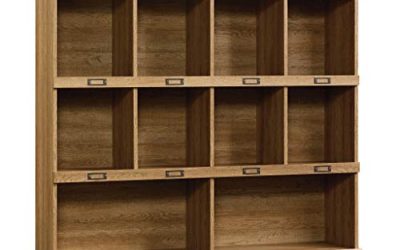
Sauder Select 5-Shelf Bookcase, Chalked Chestnut

Sauder’s Select collection five-shelf bookcase is the straightforward classic in this group: a tall engineered-wood case, roughly 69.8 inches high, 29.4 inches wide and 13.9 inches deep, finished here in Chalked Chestnut. Five spacious shelves hold books, binders, bins and display pieces, and three of the shelves are adjustable so you can set the openings to the height your collection needs.
The extra depth compared with the Concepts In Wood unit is its quiet advantage. At close to 14 inches deep, the shelves swallow large cookbooks, board games and storage bins that would crowd a shallower case, which makes it a flexible pick for a living-room library that also stores everyday items. The enclosed back and traditional framed styling keep it looking like furniture rather than a utility rack.
What it does not give you is a published per-shelf load figure in its standard listing copy, so heavy loads should be distributed sensibly and the fixed shelves used for the densest rows. It is also a single-width unit, so a full wall means lining up several cases, and the laminate finish cannot be sanded and refinished the way solid wood can.
Best for: readers who want a deep, tall, general-purpose library case for mixed books and storage.
Camaflexi Shaker Style 6-Shelf Bookcase, 72-Inch, Cherry

The Camaflexi Shaker case is the solid-wood option. It is crafted from solid pine wood sourced from renewable pine plantations and finished with a multi-step urethane coating that protects the surface while showing the grain. The 72-inch model linked here, in Cherry, stands 30 inches wide and 13 inches deep with a closed back and traditional Shaker styling.
Its six shelves divide into four adjustable shelves and two fixed shelves, the most adjustable shelves of any single-width case in this roundup. Published figures for this model put the maximum capacity at about 40 pounds per shelf, which combined with solid pine construction makes it a reassuring place for heavy hardcovers that might bow a thin engineered-wood shelf over time. The closed back also keeps books from sliding through and gives the case a finished look from the front.
The compromises are width and material care. At 30 inches wide it stores less per unit than the double-wide Concepts In Wood case, so a large library means buying several. Solid pine is also softer than the veneers and laminates elsewhere here, so it can pick up dents from heavy use, and it should be kept out of persistently damp rooms.
Best for: readers who want real solid wood, a refinishable surface and four adjustable shelves in a classic library style.
Sauder Miscellaneous Storage Bookcase With Doors, Chalked Chestnut

This second Sauder takes the same five-shelf formula and adds a pair of doors over the lower section, creating hidden storage behind them while the upper shelves stay open for display. Three of its shelves are adjustable, so the open section can still be tuned for tall books, framed photos or decorative pieces, and the Chalked Chestnut finish matches the other case above if you want a mixed wall of open and closed units.
The closed lower section is the reason to choose it. A home library often includes things that do not display well: charging cables, board game boxes, paperwork, spare liners and cleaning supplies. Behind doors, that clutter disappears and the room keeps its reading-room calm, while the open shelves above carry the books you actually want to see.
The cost of the doors is flexibility. The enclosed section fixes part of the interior layout, so this case adapts to fewer odd-shaped items than the fully open Sauder Select, and like its sibling it is an engineered-wood case with a laminate finish rather than solid wood. Treat the doors gently, since their hinges and panels are the most wear-prone parts of the design.
Best for: living-room libraries that need part of the storage hidden from view.
Comparison table
| Bookcase system | Dimensions (W x D x H) | Shelves | Adjustable / fixed | Material | Stated load per shelf |
|---|---|---|---|---|---|
| Concepts In Wood Traditional Double-Wide, 84-Inch | 48 x 10.63 x 84 in | 12 | 10 adjustable / 2 fixed | Genuine wood veneers, solid wood molding | 70 lb |
| Bush Furniture Cabot Tall 5 Shelf | 31.7 x 12.83 x 66.65 in | 5 | 3 adjustable / 2 fixed | Engineered wood | 25 lb |
| Sauder Select 5-Shelf, Chalked Chestnut | 29.37 x 13.9 x 69.76 in | 5 | 3 adjustable / 2 fixed | Engineered wood | Not stated in listing copy |
| Camaflexi Shaker Style 6-Shelf, 72-Inch | 30 x 13 x 72 in | 6 | 4 adjustable / 2 fixed | Solid pine wood | About 40 lb |
| Sauder Miscellaneous Storage Bookcase With Doors | 29.37 x 13.9 x 69.76 in | 5 | 3 adjustable / 2 fixed | Engineered wood | Not stated in listing copy |
Frequently asked questions
How many adjustable shelves does a library bookcase need?
For a mixed collection, three adjustable shelves per case is a workable minimum, because paperbacks, hardcovers and tall items each need a different opening height. If your library includes many oversized volumes, a case with more movable shelves, such as the ten-adjustable-shelf Concepts In Wood unit, saves the most wasted space.
Can these bookcases really be combined into one library wall?
Yes, that is the idea behind a bookcase system. The Bush Furniture Cabot is designed to be grouped with matching units, and the two Sauder cases share a finish and near-identical dimensions, so open and doored units can alternate along one wall. Measure the full run before ordering and leave room for baseboards.
Are solid wood bookcases always stronger than engineered wood?
Not automatically. What matters most is the stated load per shelf and the shelf span. The veneered Concepts In Wood double-wide carries the highest stated per-shelf figure here, while the solid pine Camaflexi provides a surface that resists sag and can be refinished. Check the numbers for the model you choose rather than relying on the material alone.
Do tall bookcases need to be fixed to the wall?
Yes. Any case over about five feet tall should be anchored, especially in homes with children or pets, and most of these units include wall-attachment hardware for exactly that purpose. Anchoring also keeps a fully loaded case from creeping forward on carpet.
What shelf depth suits a home library?
Most hardcovers sit comfortably on shelves 10 to 12 inches deep. Deeper cases around 14 inches, like the Sauder models here, add room for bins and large-format books but take more floor space, while the shallower 10.63-inch Concepts In Wood case suits paperback-heavy collections and tighter rooms.
Conclusion
For a true library wall, the Concepts In Wood double-wide case is the standout: ten adjustable shelves, a 70-pound stated capacity per shelf and an 84-inch frame that anchors a reading room. The Bush Furniture Cabot is the better system for building gradually, since matching units group cleanly and each case is light enough to manage. Choose the Sauder Select for depth and simplicity, the Camaflexi when solid pine and four adjustable shelves matter most, and the doored Sauder when part of the library needs to stay out of sight. Whichever system you pick, count the adjustable shelves before you buy, and anchor the finished wall.