Key takeaways
- Five tall library bookcase systems for large book collections, compared by shelf strength, storage layout and closed cabinets for a home library.
A book collection rarely stays the size it was when the first shelf went up. One more series, one more reference set, one more box from a move, and suddenly the books are stacked sideways on top of upright rows. The real decision is not which bookcase looks nicest in a photo. It is how many linear feet of shelving a collection needs, how much weight each shelf must carry, and how much of the collection should sit behind doors instead of out in the open.
This guide is for readers with a growing collection, a home library in progress, or a full wall waiting to be filled. It covers collectors who shelve by subject, families sharing one reading room, and anyone replacing a set of mismatched shelves with a single coherent system. Every product below was selected from its name and specifications on its Amazon listing, with the measurements and load figures the listing itself states.
Quick Picks
As an Amazon Associate we earn from qualifying purchases.
| Product | Best for | Key spec |
|---|---|---|
| Sauder Barrister Lane Bookcase | Cubby-style sorting by subject or series | 10 cubby compartments |
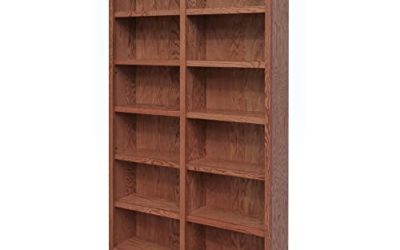
| Sauder Select Book Shelf | A classic library look with hidden storage | Doors plus adjustable shelves |
| Tribesigns 72-Inch 6-Tier Bookcase | Tall open shelving for a full wall | 72 inches tall, 6 tiers |
| HOSTACK 75-Inch 6-Tier Bookcase with Cabinet | Wide wall coverage with a closed cabinet | 46.85 inches wide, 450 lb capacity |
| IRONCK 70-Inch Industrial Bookcase with Doors | Narrow rooms that still need closed storage | 70.9 inches tall, 22 lb per tier |
How to Choose
Measure the wall and the books first
Start with a tape measure, not a catalogue. Record the width of the wall, the ceiling height, and the depth of the largest books in the collection, because oversized art books and atlases need deeper shelves than paperbacks. A tall unit uses vertical space well, but a bookcase that is wider than the wall section it sits on will crowd doorways and walkways. Count the collection in linear feet of shelf space rather than in bookcases, and leave one shelf partly open so new arrivals have somewhere to go.
Match shelf strength to the weight of books
Books are heavier than they look, and a shelf that bows under hardcovers will not recover. Check the load figure for each shelf instead of the total for the whole unit, since a single row of dense reference books can reach that limit on its own. Units in this guide state per-shelf figures from 22 lb upward, which suits ordinary novels and paperbacks, while heavier sets belong on the lowest shelves where the frame carries them best. Spread reference works across several shelves rather than loading one level.
Decide how much stays behind doors
Open shelves make a collection easy to browse, but every open row collects dust and catches daylight. Doors protect the books that are read least often, hide overflow and mismatched spines, and keep a room looking calm when the collection is large. A good library system mixes the two: open shelving at eye level for current reading and display, closed cabinets below for archives, duplicates and items that do not need to be seen. Think about which part of the collection deserves to be on show before choosing the ratio.
Plan for growth and safe placement
A collection that is still growing needs shelves that move. Adjustable shelving lets tall volumes stand upright instead of lying flat, and a unit that matches a second identical one lets the wall extend later without a mismatched join. Tall freestanding bookcases should be anchored to the wall with the anti-tip hardware supplied, especially in homes with children or pets, and placed on a level floor so doors close squarely. Assembly is part of the decision too, so check the footprint and the packed weight before ordering.
The 5 Best Options
Sauder Barrister Lane Bookcase

The Barrister Lane suits collectors who sort by subject, author or series and want each group to have its own defined space. Its cubby layout turns a single bookcase into a set of small compartments, so a row of novels, a run of reference volumes and a stack of oversized books each sit in a bay of their own instead of sliding together along one long shelf. The Scribed Oak finish gives it the look of traditional library furniture, and the low, wide shape works under a window or along a short wall where a tall tower would feel out of place.
Specs
- Finish: Scribed Oak
- Layout: 10 cubby compartments across three rows
- Design: open cubby shelving for books and display items
- Style: barrister-style library bookcase
Best for: collectors who sort books into subject groups and want each group in its own compartment.
Watch out for: the cubby openings set a limit on the height of books in each bay, so measure the tallest volumes before choosing this layout.
Sauder Select Book Shelf

The Select Book Shelf fits readers who want the classic library look without giving up hidden storage. Doors at the base conceal the overflow that every large collection produces, while the open shelves above keep current reading within reach and on display. Adjustable shelves let the spacing follow the books rather than the other way round, so a row of tall hardcovers and a row of paperbacks can share one unit without wasted gaps. The Vintage Oak finish reads as traditional library furniture in a living room or study.
Specs
- Finish: Vintage Oak
- Storage: doors plus adjustable shelves
- Shelves: adjustable shelf positions
- Style: library bookcase with enclosed storage
Best for: readers who want open display shelves above and closed storage below in one traditional-looking unit.
Watch out for: confirm the door swing and the clearance in front of the unit, since the doors need room to open fully in a tight space.
Tribesigns 72-Inch 6-Tier Bookcase

The Tribesigns 72-inch bookcase is the straightforward choice for a wall of books: six open tiers, a tall frame and a clean modern outline that disappears behind the collection itself. At just over 72 inches high and 35.43 inches wide, one unit holds a substantial run of novels, and two side by side form a convincing library wall. The particleboard shelves carry a waterproof melamine finish that wipes clean, and each shelf carries up to 22 lb, which covers ordinary hardcovers and paperbacks without strain.
Specs
- Dimensions: 11.81″D x 35.43″W x 72.04″H
- Shelves: 6 tiers
- Material: particleboard with waterproof melamine finish
- Load: 22 lb per shelf, 132 lb total
- Item weight: 78.3 lb
- Mounting: freestanding
Best for: building a tall open library wall from one or more matching units.
Watch out for: the open back and open shelves leave books exposed to dust and daylight, so this unit suits rooms where the collection is used often rather than stored long term.
HOSTACK 75-Inch 6-Tier Bookcase with Cabinet
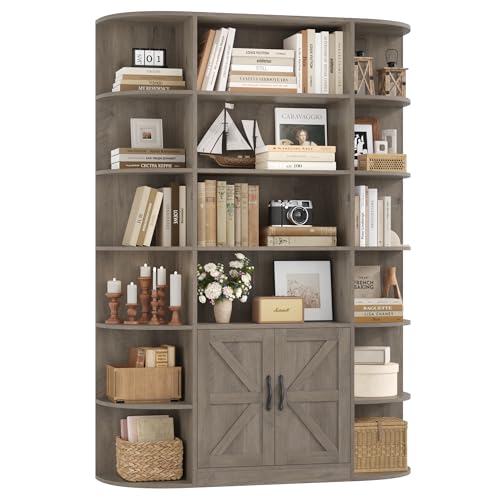
The HOSTACK is the widest unit in this guide, and that width is its main strength. At 46.85 inches across and 74.8 inches tall, a single case covers a large stretch of wall and holds six tiers of open shelving above a book storage cabinet with a door. The total capacity of 450 lb is the highest here, which matters for collectors with dense hardcover runs. MDF construction with an Ash Grey finish and black handles gives it a farmhouse character that works in living rooms as well as studies.
Specs
- Dimensions: 11.8″D x 46.85″W x 74.8″H
- Material: MDF wood
- Weight capacity: 450 lb total
- Storage: 6-tier open shelving plus book storage cabinet with door
- Finish: Ash Grey with black handles
- Model: US-YY5TA6913
Best for: collectors who want maximum width and load capacity from a single unit with a closed cabinet.
Watch out for: at nearly 47 inches wide and over 106 lb, this is a two-person move and assembly job, and the route into the room needs measuring first.
IRONCK 70-Inch Industrial Bookcase with Doors

The IRONCK suits narrow rooms where a wide library wall is not possible. At 23.8 inches wide and 9.3 inches deep, it tucks beside a desk or into a corner while still reaching 70.9 inches high with six tiers. An iron frame with P2 MDF boards gives it an industrial look, and farmhouse-style doors conceal the lower section, where a shelf sits behind the doors for items that do not need to be on show. Each tier supports up to 22 lb, matching the open Tribesigns unit shelf for shelf.
Specs
- Dimensions: 23.8″W x 9.3″D x 70.9″H
- Material: P2 MDF board with iron frame
- Shelves: 6 tiers, 22 lb per tier
- Doors: farmhouse-style doors with a shelf behind
- Finish: Vintage Brown
- Model: 1039162
Best for: narrow spaces, corners and home offices that need tall storage without a wide footprint.
Watch out for: the 9.3-inch depth fits standard novels and paperbacks but not oversized art books, so measure the deepest volumes in the collection first.
Which One Fits Your Situation
A whole wall of books in a home library
Choose the Tribesigns 72-inch bookcase, two or three units side by side, for a full library wall. The uniform height and width line up cleanly, the open tiers keep every spine visible, and the per-shelf load figure is honest about what each level can hold. Add the HOSTACK at one end if the wall needs a closed cabinet for archives.
A growing collection in a small room
Choose the IRONCK 70-inch bookcase for a small room. Its narrow footprint leaves floor space free, the doors hide the overflow that a growing collection always produces, and the tall frame still gives six tiers of storage. When the collection outgrows a single unit, a second matching case fits the same narrow profile without a new plan.
Mixed books and display objects in a living room
Choose the Sauder Barrister Lane for a living room where books share space with objects. The cubby compartments separate books from display pieces naturally, so framed photographs, vases and keepsakes each get a bay of their own. The low wide shape sits comfortably under a window or beside a sofa without dominating the room.
Heavy hardcovers and reference sets
Choose the HOSTACK 75-inch bookcase for heavy material. Its 450 lb total capacity is the strongest in this guide, and the wide shelves spread reference sets across fewer, sturdier levels. Keep the heaviest volumes on the lowest shelves and reserve the closed cabinet for the sets that are consulted least.
Common Mistakes
- Counting books instead of measuring linear feet of shelf space, which understates how much room a collection really needs.
- Buying shelves too shallow for the largest volumes, so oversized books stick out past the front edge.
- Skipping the anti-tip anchor on a tall freestanding unit, especially in a room used by children or pets.
- Loading one shelf to its limit while leaving others empty, instead of spreading heavy books across several levels.
- Choosing open shelving for the entire collection, then finding dust and daylight ageing the books that are rarely taken down.
Frequently Asked Questions
How many books does a tall 6-tier bookcase hold?
It depends on shelf length and book thickness rather than on the number of tiers alone. A 35-inch-wide shelf holds roughly two dozen standard novels per level, so a six-tier unit of that width holds well over a hundred volumes. Measure the collection in linear feet and compare it with the total shelf length before deciding how many units are needed.
Do tall bookcases need to be anchored to the wall?
Yes, any tall freestanding bookcase should be secured with the anti-tip hardware supplied with it. A fully loaded unit is top-heavy, and a pull on an upper shelf or a bump from a pet can tip it forward. Anchoring takes a few minutes during assembly and keeps the unit stable for as long as it stands in the room.
Are open shelves or doors better for a large collection?
A mix of both works best for most collections. Open shelves suit the books in current use, since they are easy to browse and reach. Doors suit archives, duplicates and volumes that are rarely opened, because they keep out dust and daylight. Plan which part of the collection belongs in each category before choosing a unit.
Can two bookcases sit side by side to form a library wall?
Yes, provided the units match in height, depth and finish, so the join looks deliberate rather than accidental. Measure the wall first, leave a small gap for skirting boards, and anchor each unit separately. Matching pairs from the same product line give the cleanest result and let the wall grow one unit at a time.