Key takeaways
- A 2000 7.3L Powerstroke runs two Group 65 batteries in parallel. Compare three AGM options by CCA and reserve, and learn why the pair must be replaced together.
As an Amazon Associate we earn from qualifying purchases.
Affiliate Disclosure: This article contains affiliate links to products on Amazon. If you buy through those links, we may earn a commission at no extra cost to you. Specifications below come from the manufacturers’ Amazon listings and published data sheets, not from detailed research by us, and availability can change — confirm fitment, quantity and stock on the product page before you order.
The one fact that shapes everything: this truck has two batteries
A 2000 Ford Super Duty with the 7.3L Powerstroke diesel does not run on a single battery. It uses two 12-volt batteries wired in parallel — one on each side of the engine bay — feeding one starter and one set of glow plugs. Together the pair has to do a job no gasoline truck asks of its battery: heat eight glow plugs in cold weather, then spin a high-compression diesel engine fast enough to build the oil pressure the fuel injection system depends on. Cranking speed is not a comfort feature on a 7.3L; the high-pressure oil system needs real cranking rpm before the injectors can fire at all, which is why a 7.3 that cranks slowly often will not start even though it sounds close.
The factory fitment for this truck is BCI Group 65. Every pick in this guide is a Group 65 battery, and every recommendation assumes the same purchase decision: buy two of the same battery, from the same model line, and install them at the same time. The sections below explain why that rule is not sales pressure but basic electrical reality for a parallel pair, then compare three Group 65 AGM options by cranking power, reserve capacity, construction, and documentation.
Quick comparison — remember, you need two
| Pick | ASIN | Group | CCA (per battery) | Capacity | Reserve capacity | Construction |
|---|---|---|---|---|---|---|
| Odyssey ODX-AGM65 Extreme | B091GV65V7 | 65 | 930 | See listing for Ah rating | 135 minutes | AGM, thin-plate pure lead |
| WEIZE Platinum AGM Group 65 | B0G5115BXS | 65 | 750 | 70 Ah | 120 minutes | AGM |
| Interstate MTX-65 AGM | B0CMWXKNZW | 65 | 750 | 68 Ah | See listing | AGM, pure lead design |
Read the CCA column with the parallel setup in mind. Two healthy batteries in parallel share the cranking load, so the pair delivers far more combined cranking capacity than either unit alone — but only when both are healthy and closely matched. A pair is only as strong as its weaker battery, which is the whole subject of the next sections.
Why you must replace both batteries together
In a parallel pair, the two batteries are electrically one large battery. They charge together, discharge together, and — critically — they age together whether you want them to or not. When one battery weakens, its internal resistance changes and it stops sharing the load evenly. The stronger battery then works harder during every start, and during rest periods the pair can trade charge back and forth, quietly draining each other. The visible result is a truck that got a brand-new battery and still cranks slowly six months later, because the old battery has been dragging the new one down since the day it was installed.
Mixing models is nearly as bad as mixing ages. Two batteries with different capacities, different CCA ratings, or different construction — say an AGM on one side and a flooded battery on the other — have different charging behaviour and different internal resistance, so they never share work evenly. The fix is simple and absolute: same brand, same model, same group size, bought at the same time, ideally with date codes close together. If one battery of a matched pair fails early under warranty, that is the one exception worth discussing with the seller; in normal service, replace the pair as a pair and budget for two batteries from the start. Every price comparison for this truck should be a comparison of pairs.
1. Odyssey ODX-AGM65 Extreme — the high-output pick for cold climates
The Odyssey ODX-AGM65 Extreme Series is the output leader in this guide. Its Amazon listing identifies the model as the ODX-AGM65 (model 65-PC1750T), an AGM battery built on EnerSys thin-plate pure lead technology, and published figures for this model line cite 930 CCA and 135 minutes of reserve capacity — substantially more cranking power per battery than the standard Group 65 rating. In a dual-battery 7.3L, that headroom shows up exactly where this engine needs it: fast, sustained cranking on a cold morning after the glow plugs have already taken their share of the pair’s energy.
Odyssey built its reputation on this pure-lead plate design, which packs more plate surface into the case than a conventional lead-calcium layout and is known for strong cranking delivery and deep-discharge recovery. For a working 2000 Super Duty — a truck that may run a winch, auxiliary lighting, a trailer with its own electrical demands, or long idle periods between hard starts — that recovery behaviour matters as much as the headline CCA figure. The trade-offs are weight, a premium position in the market, and the need to check the exact rating plate figures on the current listing, because Odyssey sells related Group 65 models (including the ODP line) with different ratings; make sure the listing you order is the ODX-AGM65 named here.
Who it suits: owners in genuinely cold regions, owners whose trucks work hard electrically, and anyone planning to keep a 2000 7.3L for years and wanting the strongest cranking margin a Group 65 case can hold. Buy two, install them together, and the pair gives this engine the cranking speed it was designed around.
2. WEIZE Platinum AGM Group 65 — the matched-pair value pick
The WEIZE Platinum AGM in Group 65 is listed at 12 volts, 70 amp-hours, 750 CCA, and 120 minutes of reserve capacity, in a case of roughly 12 by 7.56 by 7.56 inches, with a stated 36-month warranty and support for start-stop duty. Those numbers meet the Group 65 job description honestly: 750 CCA per battery is the rating class this truck’s original specification was built around, and in a matched parallel pair it provides confident starting in most climates, with the AGM construction adding vibration resistance and sealed, maintenance-free operation.
WEIZE’s own product material for this model describes an AGM design intended for high electrical loads and longer cycle life than a conventional flooded battery. For a 25-year-old truck, the practical benefits are the unglamorous ones: no watering, less terminal corrosion to chase, and better tolerance of the vibration a big diesel makes at idle. Because replacing a pair doubles every cost, the value position of this battery is a genuine argument — two WEIZE batteries deliver the correct group size, chemistry, and rating class as a matched set without reaching the premium tier, and the stated warranty term is published in plain language on the listing.
Who it suits: owners who want a correct, matched AGM pair with clearly published specifications and warranty terms, and whose trucks live in mild-to-moderate cold rather than sustained deep-winter service. As always with this brand, warranty and returns run through the seller, so confirm the current process on the product page before ordering two.
3. Interstate MTX-65 AGM — the established-name pure lead option
The Interstate MTX-65 is a Group 65 AGM battery listed at 12 volts, 68 amp-hours, and 750 CCA. Interstate describes its MTX line as an automotive pure lead AGM design that packs more lead into the battery, is spill-proof and vibration-resistant, and is intended to meet or exceed a vehicle’s starting requirements while also powering accessories and plug-ins. The brand claims a service life two to three times that of certain conventional battery types; treat that as a manufacturer claim rather than a guarantee for any individual truck, but the construction story behind it — pure lead plates in an AGM case — is the same technology family as the premium pick above, from one of the longest-established battery names in North America.
That dealer and service network is part of the real-world case for this battery. Interstate batteries are supported through a wide physical network, which some owners value for warranty handling on a heavy item that is awkward to ship. The honest limitation is documentation at the listing level: the product information directs buyers to a compatibility guide to verify fit, and does not publish every dimension and terminal detail in the listing itself. For this truck the check is straightforward — Group 65 is the specified size for the 2000 7.3L Super Duty — but confirm terminal layout against your old batteries before ordering, as you should with any battery.
Who it suits: owners who prefer an established national brand and its service footprint, want pure lead AGM construction at the standard 750 CCA rating class, and are comfortable doing the basic fitment confirmation the listing asks for. Again: order two of the same model at the same time.
How much CCA does a 7.3 Powerstroke really need?
Start from the original specification class: Group 65 batteries rated around 750 CCA per battery have been the standard fitment class for these trucks, and a healthy matched pair at that rating starts a healthy 7.3L reliably in most conditions. The case for more — the Odyssey’s higher rating — is about margin, not minimums. Margin matters when several real-world factors stack up: a cold-soaked engine with thick oil, glow plugs drawing heavily before cranking even begins, an ageing starter that draws more current than it did when new, battery cables with a quarter-century of corrosion creeping through them, and batteries that are themselves a few years old and no longer at full strength.
If your truck lives where winter means sustained temperatures well below freezing, or if it must start first try, every time, for work, the higher-output pair earns its keep. If your truck lives in a mild climate and starts daily, a matched pair at the standard rating is a rational choice, and money saved is better spent on the items in the next section — because on a 2000 truck, the batteries are often only part of the starting problem.
Before you blame the batteries: cables, glow plugs, and the starter
A 7.3L that cranks slowly on two new batteries is telling you the problem is elsewhere, and these trucks have three usual suspects. First, the battery cables and interconnect cable between the two batteries. Corrosion inside the cable insulation and at the terminals adds resistance exactly where the starter needs hundreds of amps; cables that are swollen, green, or stiff are done, and the crossover cable between the pair is as important as the main cables. Second, the glow plug system: failed glow plugs or a failed glow plug relay make cold starting hard no matter how strong the batteries are, and the classic symptom is a truck that starts fine warm and refuses cold. Third, the starter itself, which wears and draws more while delivering less.
Test in a sensible order. A healthy, charged lead-acid battery rests at roughly 12.6 volts; check both batteries individually after the truck has sat, and load-test them separately if you can — testing the pair together can hide one weak battery behind the stronger one, which is precisely the failure mode this guide warns about. If both batteries test well and cranking is still slow, move to cables and connections, then the glow plug system, then the starter. Replacing batteries without this check is how owners end up with new batteries and the same no-start.
Installation notes for the dual-battery setup
Replacing a pair is two ordinary battery swaps plus one discipline: treat the two sides as one system. Switch everything off and remove the key. On each side, remove the negative cable first and the positive last-off, and reverse that order on installation, so a wrench can never short a positive terminal against the body. Photograph both sides before you start if the cable routing is unfamiliar — the interconnect cable routing matters and memory is unreliable under a hood.
Clean every terminal and cable end while the batteries are out, inspect the trays and hold-downs, and replace any hold-down hardware that is cracked or missing; a loose battery in a diesel that shakes at idle will not live a long life. Lift with two hands or a strap: Group 65 batteries are heavy, and there are two of them. Install both new batteries before connecting everything, connect positives first and negatives last, and protect the terminals against corrosion. Then run the truck, check charging behaviour, and confirm both batteries sit at the same resting voltage the next morning — a noticeable difference between the pair on day one is worth investigating immediately, not after the first cold snap. Return both old batteries through the seller’s or a local store’s recycling and core programme.
Frequently asked questions
How many batteries does a 2000 7.3 Powerstroke have? Two. The 7.3L diesel Super Duty uses a pair of 12-volt Group 65 batteries wired in parallel, one on each side of the engine bay, sharing starting and glow plug loads.
Can I replace just one battery if only one tests bad? You can, but you should not plan to. The new battery will be dragged toward the old battery’s condition because the pair charges and discharges as one unit, and uneven load sharing shortens the new battery’s life. Replace both with the same model at the same time; the only routine exception is an early warranty failure of one battery in a young, matched pair.
Can I mix an AGM and a flooded battery, one on each side? No. Different construction means different internal resistance and charging behaviour, so the pair will not share work evenly. Pick one model line and buy two of it — all three picks in this guide are AGM, and any of them works as a matched pair.
What group size and CCA should I buy? Group 65, at the standard rating class of about 750 CCA per battery or higher. The Odyssey ODX-AGM65 offers a higher-output option at a listed 930 CCA for cold climates and hard electrical use; the WEIZE and Interstate options sit at the standard 750 CCA class with 70 and 68 amp-hours respectively.
My truck still cranks slowly with new batteries. What now? Check the interconnect and main cables for internal corrosion, test the glow plugs and their relay, and have the starter draw tested. On a truck of this age, cables are the most commonly overlooked cause, and no battery pair can push full current through a cable that has rotted from the inside.
How long should a matched pair last? It depends on heat, discharge habits, cable condition, and charging health. A matched AGM pair that is kept charged and clamped down securely will generally serve for years; a pair that is repeatedly deep-discharged by a parasitic drain or a failing alternator will not, whatever brand is on the label. If one side of the engine bay runs noticeably hotter or a battery repeatedly tests lower than its partner, look for the truck-side cause rather than replacing batteries on a cycle.
Our verdict
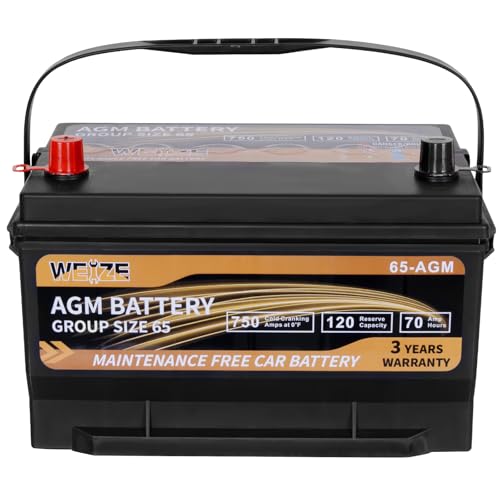
For most 2000 7.3 Powerstroke owners, the WEIZE Platinum AGM Group 65 (ASIN B0G5115BXS) is the sensible matched pair: correct Group 65 size, 750 CCA and 70 amp-hours per battery, 120 minutes of reserve, sealed AGM construction, and a clearly stated 36-month warranty — bought as two identical batteries and installed together. Choose the Odyssey ODX-AGM65 Extreme (ASIN B091GV65V7) as your pair if the truck works in serious cold or carries heavy electrical loads and you want the largest cranking margin in this case size. Choose the Interstate MTX-65 (ASIN B0CMWXKNZW) if an established brand and its service network matter most to you. The brand matters less than the rule, though: two of the same battery, same age, same model, every time. That discipline, plus healthy cables, is what makes a 7.3L start like it should.